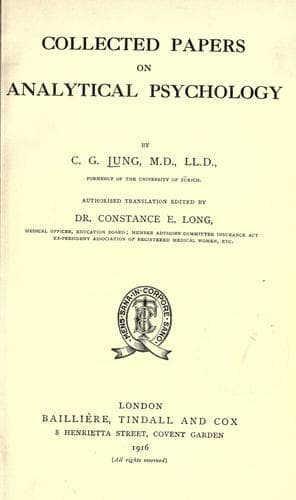
Collected Papers on Analytical PsychologyJung, C. G. (Carl Gustav)
Science
Collected Papers on Analytical Psychology
Jung, C. G. (Carl Gustav)
Psychoanalysis
I have presented my view of the psychological basis in a work[195]
whose scientific validity has been contested upon all sorts of grounds.
For me it is sufficient justification that a psychiatrist of Bleuler's
standing has fully accepted, in his great monograph on the disease,
all the essential points in my work. The difference between us is as
to the question whether, in relation to the anatomical basis, the
psychological disorders should be regarded as primary or secondary. The
resolution of this weighty question depends upon the general problem as
to whether the prevailing dogma in psychiatry--"disorders of the mind
are disorders of the brain"--presents a final truth or not. This dogma
leads to absolute sterility as soon as universal validity is ascribed
to it. There are undoubted psychogenic mental diseases (the so-called
hysterical) which are properly regarded as _functional_ in contrast
with organic diseases which rest upon demonstrable anatomical changes.
Disorders of the brain should only be called organic when the psychic
symptoms depend upon an undoubtedly primary disease of the brain. Now
in dementia præcox this is by no means a settled question. Definite
anatomical changes are present, but we are very far from being able to
relate the psychological symptoms to these changes. We have, at least,
positive information as to the functional nature of early schizophrenic
conditions; moreover the organic character of paranoia and many paranoid
forms is still in great uncertainty. This being so it is worth while
to inquire whether manifestations of degeneration could not also be
provoked by psychological disturbance of function. Such an idea is only
incomprehensible to those who smuggle materialistic preconceptions into
their scientific theories. This question does not even rest upon some
fundamental and arbitrary spiritualism, but upon the following simple
reflection. Instead of assuming that some hereditary disposition, or a
toxæmia, gives rise directly to organic processes of disease, I incline
to the view that upon the basis of predisposition, whose nature is
at present unknown to us, there arises a non-adaptable psychological
function which can proceed to develop into manifest mental disorder;
this may secondarily determine organic degeneration with its own train
of symptoms. In favour of this conception is the fact that we have no
proof of the primary nature of the organic disorder, but overwhelming
proofs exist of a primary psychological fault in function, whose history
can be traced back to the patient's childhood. In perfect agreement
with this conception is the fact that analytic practice has given us
experience of cases where patients on the borderline of dementia præcox
have been brought back to normal life.
Public-domain text, read in full here on John Shaqi.
Reviews
Reviews
No reviews yet
Be the first to share your thoughts on this work.
Elsewhere in the archive
Join the Discussion
Join the discussion
Sign in to leave a comment or review.
Sign InorCreate an account