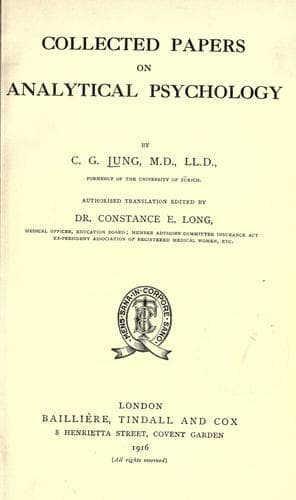
Collected Papers on Analytical PsychologyJung, C. G. (Carl Gustav)
Science
Collected Papers on Analytical Psychology
Jung, C. G. (Carl Gustav)
Psychoanalysis
Even if anatomical lesions or organic symptoms were constantly present,
science ought not to imagine the psychological standpoint could
advisedly be neglected, or the undoubted psychological relationship
be given up as unimportant. If, for instance, carcinoma were to prove
an infectious disease the peculiar growth and degenerative process
of carcinomatous cells would still be a constant factor requiring
investigation on its own account. But, as I have said, the correlation
between the anatomical findings and the psychological picture of
the disease is so loose that it is extremely desirable to study the
psychological side of it thoroughly.
PART I
Psychiatry is the stepchild of medicine. All the other branches of
medicine have one great advantage over it--the scientific methods can be
applied; there are things to be seen, and felt, physical and chemical
methods of investigation to be followed: the microscope shows the
dreaded bacillus, the surgeon's knife halts at no difficulty and gives
us glimpses of most inaccessible organs of vital importance. Psychiatry,
which engages in the exploration of the mind, stands ever at the door
seeking in vain to weigh and measure as in the other departments of
science. We have long known that we have to do with a definite organ,
the brain; but only beyond the brain, beyond the morphological basis
do we reach what is important for us--the mind; as indefinable as it
ever was, still eluding any explanation, no matter how ingenious.
Former ages, endowing the mind with substance, and personifying every
incomprehensible occurrence in nature, regarded mental disorder as the
work of evil spirits; the patient was looked upon as one possessed,
and the methods of treatment were such as fitted this conception. This
mediæval conception occasionally gains credence and expression even
to-day. A classical example is the driving out of the devil which
the elder Pastor Blumhardt carried out successfully in the famous
case of Gottlieb in Deltus.[196] To the honour of the Middle Ages
let it also be said that there are to be found early evidences of a
sound rationalism. In the sixteenth century at the Julius Hospital in
Würzburg mental patients were already treated side by side with others
physically ill, and the treatment seems to have been really humane.
With the opening of the modern era, and with the dawn of the first
scientific ideas, the original barbaric personification of the unknown
Great Power gradually disappeared. A change arose in the conception of
mental disease in favour of a more philosophic moral attitude. The old
view that every misfortune was the revenge of the offended gods returned
new-clothed to fit the times. Just as physical diseases can, in many
cases, be regarded as self-inflicted on account of negligence, mental
diseases were likewise considered to be due to some moral injury, or
sin. Behind this conception the angry godhead also stood. Such views
Public-domain text, read in full here on John Shaqi.
Reviews
Reviews
No reviews yet
Be the first to share your thoughts on this work.
Elsewhere in the archive
Join the Discussion
Join the discussion
Sign in to leave a comment or review.
Sign InorCreate an account