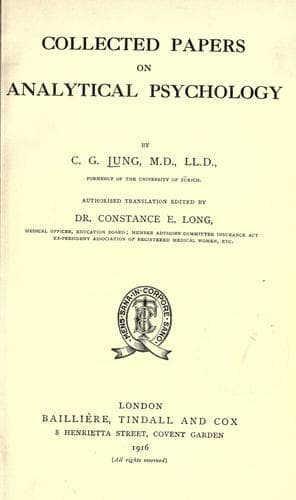
Collected Papers on Analytical PsychologyJung, C. G. (Carl Gustav)
Science
Collected Papers on Analytical Psychology
Jung, C. G. (Carl Gustav)
Psychoanalysis
Psychiatry has come into fame as gross materialism. And quite rightly,
for it is on the road--or rather reached it long ago--to put the organ,
the instrument, above function. Function has become the dependent
accessory of its organs, the mind the dependent accessory of the brain.
In modern mental therapy the mind has been the loser, whilst great
progress has been made in cerebral anatomy; of the mind we know less
than nothing. Current psychiatry behaves like a man who thinks he can
unriddle the meaning and importance of a building by a mineralogical
investigation of its stones. Let us attempt to realise in which mental
diseases obvious changes in the brain are found, and what is their
proportion.
In the last four years we have received 1325 patients at Burgholzi;[197]
331 a year. Of these 9 per cent. suffered from congenital psychic
anomalies. By this is understood a certain inborn defect of the psyche.
Of these 9 per cent., about a quarter were imbeciles. Here we meet
certain changes in the brain such as microcephalus, hydrocephalus,
malformations or absence of portions of the brain. The remaining
three-quarters of these congenital defects present no typical changes in
the brain.
Three per cent. of our patients suffer from epileptic mental troubles.
In the course of epilepsy there arises gradually a typical degeneration
of the brain. The degeneration is, however, only discoverable in severe
cases and when the disease has existed for some time. If the attacks
have only existed for a relatively short time, not more than a few
years, the brain as a rule shows nothing. Seventeen per cent. of our
patients suffer from progressive paralysis and senile dementia. Both
diseases present characteristic changes in the brain. In paralysis there
is most extensive shrinkage of the brain, so that the cortex is often
reduced by one half. The frontal portions of the brain more especially,
may be reduced to a third of the normal weight. There is a similar
destruction of substance in senile decay.
Fourteen per cent. of the patients annually received are cases of
poisoning, at least 13 per cent. of these being due to alcohol. As a
rule in slight cases nothing is to be found in the brain; in only a
relatively few severe cases is there shrinkage of the cortex, generally
of slight degree. The number of these severe cases amounts to less than
1 per cent. of the yearly cases of alcoholism.
Six per cent. of the patients suffer from so-called maniacal depressive
insanity which includes the maniacs and the melancholics. The essence
of this disease is readily intelligible to the public. Melancholia is
a condition of abnormal sadness without disorder of intelligence or
memory. Mania is the opposite, the rule being an abnormally excited
state with great restlessness; likewise without deep disturbance of
intelligence and memory. In this disease there are no demonstrable
morphological changes in the brain.
Public-domain text, read in full here on John Shaqi.
Reviews
Reviews
No reviews yet
Be the first to share your thoughts on this work.
Elsewhere in the archive
Join the Discussion
Join the discussion
Sign in to leave a comment or review.
Sign InorCreate an account