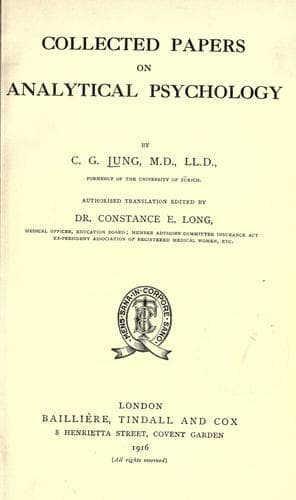
Collected Papers on Analytical PsychologyJung, C. G. (Carl Gustav)
Science
Collected Papers on Analytical Psychology
Jung, C. G. (Carl Gustav)
Psychoanalysis
played a great _rôle_, right up to the beginning of last century,
especially in Germany. In France, however, about the same time a new
idea was appearing, destined to sway psychiatry for a hundred years.
Pinel, whose statue fittingly stands at the gateway of the Salpetrière
in Paris, took away the chains from the insane and thus freed them from
the symbol of the criminal. In a very real way he formulated for the
world the humane and scientific conception of modern times. A little
later Esquirol and Bayle discovered that certain forms of insanity ended
in death, after a relatively short time, and that certain constant
changes in the brain could be demonstrated _post mortem_. Esquirol had
described as an entity general paralysis of the insane, or as it was
popularly called "softening of the brain," a disease which is always
bound up with chronic inflammatory degeneration of the cerebral matter.
Thus was laid the foundation of the dogma which you will find repeated
in every text-book of psychiatry, viz. "diseases of the mind are
diseases of the brain." Confirmation of this conception was added about
the same time by Gall's discoveries which traced partial or complete
loss of the power of speech--a psychical capacity--to a lesion in the
region of the left lower frontal convolution. Somewhat later this view
proved to be of general applicability. Innumerable cases of extreme
idiocy or other intense mental disorders were found to be caused by
tumours of the brain. Towards the end of the nineteenth century Wernicke
(recently deceased) localised the speech centre in the left temporal
lobe. This epoch-making discovery raised hopes to the highest pitch.
It was expected that at no distant day every characteristic and every
psychical activity would be assigned a place in the cortical grey
matter. Gradually, increased attempts were made to trace the primary
mental changes in the psychoses back to certain parallel changes in the
brain. Meynert, the famous Viennese psychiatrist, described a formal
scheme in which the alteration in blood-supply in certain regions was
to play the chief part in the origin of the psychoses. Wernicke made a
similar but far more ingenious attempt at a morphological explanation
of psychical disorders. The visible result of this tendency is seen in
the fact that even the smallest and least renowned asylum has, to-day,
its anatomical laboratory where cerebral sections are cut, stained, and
microscoped. Our numerous psychiatric journals are full of morphological
contributions, investigations into the structure and distribution of
cells in the cortex, and other varying source of disorders in the
different mental diseases.
Public-domain text, read in full here on John Shaqi.
Reviews
Reviews
No reviews yet
Be the first to share your thoughts on this work.
Elsewhere in the archive
Join the Discussion
Join the discussion
Sign in to leave a comment or review.
Sign InorCreate an account