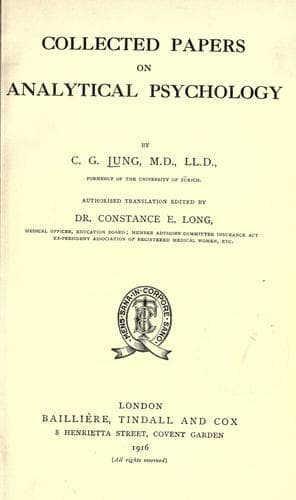
Collected Papers on Analytical PsychologyJung, C. G. (Carl Gustav)
Science
Collected Papers on Analytical Psychology
Jung, C. G. (Carl Gustav)
Psychoanalysis
where she began to tear up flowers and to scratch at the graves. She
remembered absolutely nothing of this afterwards. On the 16th she
remained with her friend without anything of importance happening. On
the 17th her friend brought her to Zürich. An acquaintance came with her
to the Asylum; on the way she spoke quite sensibly, but was very tired.
Outside the Asylum they met three boys, whom she described as the "three
dead people she had dug up." She then wanted to go to the neighbouring
cemetery, but was persuaded to come to the Asylum.
She is small, delicately formed, slightly anæmic. The heart is slightly
enlarged to the left, there are no murmurs, but some reduplication of
the sounds, the mitral being markedly accentuated. The liver dulness
reaches to the border of the ribs. Patella-reflex is somewhat increased,
but otherwise no tendon-reflexes. There is neither anæsthesia,
analgesia, nor paralysis. Rough examination of the field of vision with
the hands shows no contraction. The patient's hair is a very light
yellow-white colour; on the whole she looks her age. She gives her
history and tells recent events quite clearly, but has no recollection
of what took place in the cemetery at C. or outside the Asylum. During
the night of the 17th-18th she spoke to the attendant and declared she
saw the whole room full of dead people--looking like skeletons. She was
not at all frightened, but was rather surprised that the attendant did
not see them too. Once she ran to the window, but was otherwise quiet.
The next morning, while still in bed, she saw skeletons, but not in
the afternoon. The following night at four o'clock she awoke and heard
the dead children in the neighbouring cemetery cry out that they had
been buried alive. She wanted to go out to dig them up, but allowed
herself to be restrained. Next morning at seven o'clock she was still
delirious, but recalled accurately the events in the cemetery at C. and
those on approaching the Asylum. She stated that at C. she wanted to
dig up the dead children who were calling her. She had only torn up the
flowers to free the graves and to be able to get at them. In this state
Professor Bleuler explained to her that later on, when in a normal state
again, she would remember everything. The patient slept in the morning,
afterwards was quite clear, and felt herself relatively well. She did
indeed remember the attacks, but maintained a remarkable indifference
towards them. The following nights, with the exception of those of the
22nd and the 25th September, she again had slight attacks of delirium,
when once more she had to deal with the dead. The details of the attacks
differed, however. Twice she saw the dead in her bed, but she did not
appear to be afraid of them, she got out of bed frequently, however,
because she did not want "to inconvenience the dead"; several times she
wanted to leave the room.
Public-domain text, read in full here on John Shaqi.
Reviews
Reviews
No reviews yet
Be the first to share your thoughts on this work.
Join the Discussion
Join the discussion
Sign in to leave a comment or review.
Sign InorCreate an account