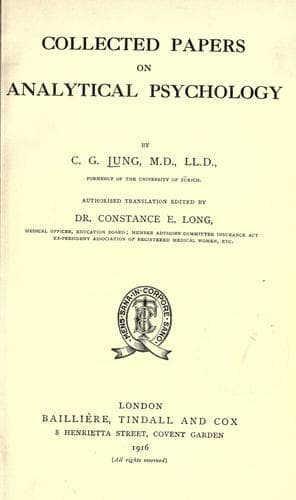
Collected Papers on Analytical PsychologyJung, C. G. (Carl Gustav)
Science
Collected Papers on Analytical Psychology
Jung, C. G. (Carl Gustav)
Psychoanalysis
He believed that he had discovered a natural law by which
a wonderful voice could be developed. He regarded himself as a great
singer, and a marvellous reciter, and at the same time he was a great
inspired poet and composer to whom verse and melody came spontaneously.
All this was in pitiable and very remarkable contrast to reality. He is
a small weakly man of unimposing build, with poorly developed muscles
betraying at the first glance the atrophying effect of his studious
life. He is unmusical, his voice is weak and he sings out of tune; he is
a bad speaker, because of his stutter. For weeks he occupied himself in
the asylum with peculiar jumping, and contortions of the body which he
called gymnastics, he sang and declaimed. Then he became more quiet and
dreamy, often stared thoughtfully in front of him for a long time, now
and then sang a love song which, despite its want of musical expression,
betrayed a pretty feeling for love's aspirations. This also was in
complete contrast with the dryness and isolation of his normal life. He
gradually became accessible for lengthy conversations.
We will break off the history of the disease here, and sum up what is
furnished so far by observation of the patient.
In the first illness the delirium broke out unexpectedly, and was
followed by a mental disorder with confused ideas and violence which
lasted for several weeks. Complete recovery appeared to have taken
place. Six years later there was a sudden outbreak of mania, grandiose
delusions, bizarre actions, followed by a twilight-stage gradually
leading to recovery. Here we again see a typical case of dementia
præcox, of the katatonic variety, especially characterised by peculiar
movements and actions. In psychiatry the views obtaining at present
would regard this as localised cellular disease of some part of the
cortex, exhibiting confusional states, delusions of grandeur, peculiar
contortions of the muscles, or twilight-states, which taken all together
have as little psychological meaning as the bizarre shapes of a drop of
lead thrown into water.
Public-domain text, read in full here on John Shaqi.
Reviews
Reviews
No reviews yet
Be the first to share your thoughts on this work.
Elsewhere in the archive
Join the Discussion
Join the discussion
Sign in to leave a comment or review.
Sign InorCreate an account