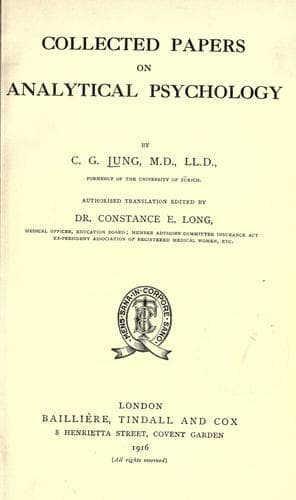
Collected Papers on Analytical PsychologyJung, C. G. (Carl Gustav)
Science
Collected Papers on Analytical Psychology
Jung, C. G. (Carl Gustav)
Psychoanalysis
This is not my view. It was certainly no accidental freak of the
brain-cells that created the dramatic contrasts shown in the second
illness. We can see that these contrasts, the so-called grandiose
delusions, were very subtly determined by the deficiencies in the
patient's personality. Without doubt, any one of us would naturally
regard these deficiencies seriously in ourselves. Who would not have
the desire to find compensation for the aridness of his profession and
of his life in the joys of poetry and music and to restore to his body
the natural power and beauty stolen from it by the study's atmosphere?
Do we not recall with envy the energy of a Demosthenes who, despite his
stammering, became a great orator? If our patient thus fulfilled the
obvious gaps in his physical and mental life by delusional wishes, the
supposition is warranted that the whispered love-song which he sang from
time to time filled up a painful blank in his being, which became more
painful the more it was concealed. The explanation is not far to seek.
It is simply the old story, born anew in every human soul, in a guise
befitting the destined creature's highest sensibilities.
When our patient was a student he learnt to know and love a
girl-student. Together they made many excursions in the environs of
the town, but his exceeding timidity and bashfulness (the lot of the
stammerer) never permitted him an opportunity of getting out the
appropriate words. Moreover, he was poor and had nothing to offer her
but hopes. The time came for the termination of his studies; she went
away, and he also, and they never saw one another again. And not long
afterwards he heard she had married some one else. Then he relinquished
his hopes, but he did not know that Eros never emancipates his slaves.
He buried himself in abstract learning, not to forget, but to work for
her in his thoughts. He wanted to keep the love in his heart quite
secret, and never to betray that secret. He would dedicate his works to
her without her ever knowing it. The compromise succeeded, but not for
long. Once he travelled through the town where he heard she lived--it
seems to have been an accident that he travelled through that town.
He did not leave the train, which only made a short halt there. From
the window he saw standing in the distance a young woman with a little
child, and thought it was she. Impossible to say whether it was really
so or not. He does not think he felt any peculiar feeling at that
moment; anyway he gave himself no trouble to ascertain whether it was
she, which makes the presumption strong that it was not really she.
The unconscious wanted to be left in peace with its illusion. Shortly
afterwards he again came to B----, the place of old memories. Then he
felt something strange stir in his soul, an uneasy feeling, akin to
Nietzsche's--
Public-domain text, read in full here on John Shaqi.
Reviews
Reviews
No reviews yet
Be the first to share your thoughts on this work.
Elsewhere in the archive
Join the Discussion
Join the discussion
Sign in to leave a comment or review.
Sign InorCreate an account