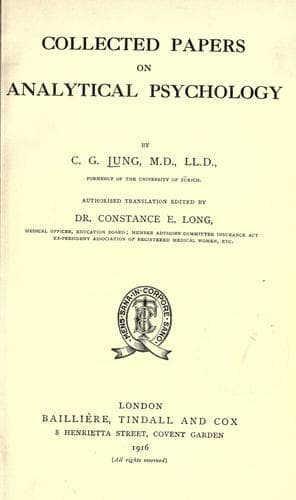
Collected Papers on Analytical PsychologyJung, C. G. (Carl Gustav)
Science
Collected Papers on Analytical Psychology
Jung, C. G. (Carl Gustav)
Psychoanalysis
The parallels with Hauptmann's Hannele show that here likewise the
artist has shown us the way with the free creation of his own phantasy.
From this coincidence, which is not accidental, we may conclude that
there is something common both to the artist and the insane and not to
them alone. Every human being has also within himself that restless
creative phantasy which is ever engaged in assuaging the harshness
of reality. Whoever gives himself unsparingly and carefully to
self-observation, will realise that there dwells within him something
which would gladly hide and cover up all that is difficult and
questionable in life, and thus procure an easy and free path. Insanity
grants the upper hand to this something. When once it is uppermost,
reality is more or less quickly driven out. It becomes a distant dream,
and the dream which enchains the patient wholly or in part, and often
for life, has now the attributes of reality. We normal persons, who have
to do entirely with reality, see only the products of disordered fancy,
but not the wealth of that side of the mind which is turned away from
us. Unfortunately only too often no further knowledge reaches us of the
things which are transpiring on that other side, because all the bridges
are broken down which unite this side with that.
We do not know to-day whether these new views are of universal or only
of limited validity; the more carefully and perseveringly we examine our
patients, the more we shall meet cases, which, despite apparent total
imbecility, will yet afford us at least some fragmentary insight into
the obscurities of the psychical life. This life is far removed from
that mental poverty which the prevailing theories were compelled to
accept.
However far we are from being able to understand fully the
concatenations of that obscure world, at least we may maintain, with
complete assurance, that in dementia præcox there is no symptom which
can be described as psychologically baseless and meaningless. The
most absurd things are in reality symbols of ideas which are not
only generally understandable, but also universally operative in the
human heart. In insanity we do not discover anything new and unknown,
but we look at the foundation of our own being, the source of those
life-problems in which we are all engaged.
PART II.[201]
The number of psychoanalytic investigations into the psychology of
dementia præcox has considerably increased since the publication of my
book upon the subject.[202] When, in 1903, I made the first analysis
of a case of dementia præcox, there dawned on me a premonition of the
possibilities of future discoveries in this sphere. This has been
confirmed.
Public-domain text, read in full here on John Shaqi.
Reviews
Reviews
No reviews yet
Be the first to share your thoughts on this work.
Elsewhere in the archive
Join the Discussion
Join the discussion
Sign in to leave a comment or review.
Sign InorCreate an account