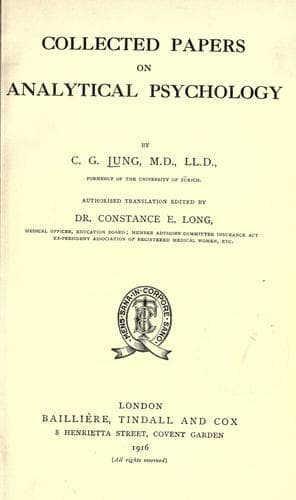
Collected Papers on Analytical PsychologyJung, C. G. (Carl Gustav)
Science
Collected Papers on Analytical Psychology
Jung, C. G. (Carl Gustav)
Psychoanalysis
Freud first submitted a case of paranoid dementia to closer
psychological investigation.[203] This he was enabled to do by means
of an analytic technique perfected through his rich experiences with
neurotics. He selected the famous autobiography of P. Schreber,
"Denkwürdigkeiten eines Nervenkranken." The patient could not be
analysed personally, but having published his most interesting
autobiography all the material wanted for an analysis was to be found in
it.
In this study Freud shows out of what infantile forms of thought and
instincts the delusional system was built up. The peculiar delusions
which the patient had about his doctor whom he identified with God
or with a god-like being, and certain other surprising and really
blasphemous ideas, Freud was able to reduce most ingeniously to his
infantile relationship to his father. This case also presented similar
bizarre and grotesque concatenations of ideas to the one I have
described. As the author himself says, his work confines itself to the
task of pointing out those universally existent and undifferentiated
foundations out of which we may say every psychological formation is
historically developed.[204] This reductive analytical process did not,
however, furnish such enlightening results in regard to the rich and
surprising symbolism in patients of this kind as we had been accustomed
to expect from the same method in the realm of the psychology of
hysteria. In reading certain works of the Zürich school, for example,
Maeder,[205] Spielrein,[206] Nelken,[207] Grebelskaja,[208] Itten,[209]
one is powerfully impressed by the enormous symbol-formation in dementia
præcox.
Some of the authors still proceed essentially by the method of analytic
reduction, tracing back the complicated delusional formation into its
simpler and more universal components, as I have done in the preceding
pages. One cannot, however, resist the feeling that this method hardly
does justice to the fulness and the almost overpowering wealth of
phantastic symbol-formation, although it does undoubtedly throw a light
upon the subject in certain directions.
Public-domain text, read in full here on John Shaqi.
Reviews
Reviews
No reviews yet
Be the first to share your thoughts on this work.
Elsewhere in the archive
Join the Discussion
Join the discussion
Sign in to leave a comment or review.
Sign InorCreate an account