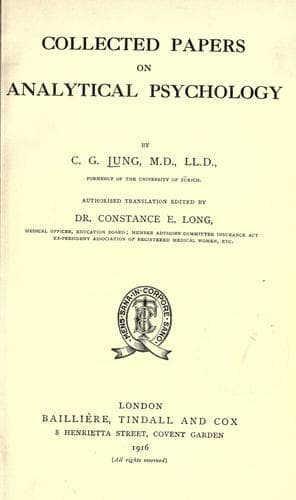
Collected Papers on Analytical PsychologyJung, C. G. (Carl Gustav)
Science
Collected Papers on Analytical Psychology
Jung, C. G. (Carl Gustav)
Psychoanalysis
The works of the Zürich school referred to contain careful and detailed
expositions of individual material. In these materials there are
very many typical formations which are unmistakably _analogies_ with
_mythological formations_[211]. There arose from the perception of
this relationship a new and valuable source for comparative study.
The acceptance of the possibility of such a comparison will not be
granted immediately, but the question is only whether the materials
to be compared really are similar or not. It will also be contended
that pathological and mythological formations are not immediately
comparable. But this objection must not be raised _a priori_, for only
a conscientious comparison can determine whether any true parallelism
exists or not. At the present moment all we know is that they are both
structures of the imagination which, like all such products, rest
essentially upon the activity of the unconscious. Experience must teach
us whether such a comparison is valid. The results hitherto obtained
are so encouraging that further work along these lines seems to me most
hopeful and important. I made practical use of the constructive method
in a case which Flournoy published in the _Archives de Psychologie_,
although he offered no opinion as to its nature at that time.
The case dealt with a rather neurotic young lady who, in Flournoy's
publication, described how surprised she was at the connected
phantasy-formations which penetrated from the unconscious into the
conscious. I subjected these phantasies, which the lady herself
reproduced in some detail, to my constructive methods and gave the
results of these investigations in my book, "The Psychology of the
Unconscious."
This book has, I regret to say, met with many perhaps inevitable
misunderstandings. But I have had one precious consolation, for my book
received the approval of Flournoy himself, who published the original
case which he knew personally. It is to be hoped that later works will
make the standpoint of the Zürich school intelligible to a wider public.
Whoever, by the help of this work, has taken the trouble to grasp the
essence of the constructive method, will readily imagine how great are
the difficulties of investigation, and how much greater still are the
difficulties of objective presentation of such investigations.
Public-domain text, read in full here on John Shaqi.
Reviews
Reviews
No reviews yet
Be the first to share your thoughts on this work.
Elsewhere in the archive
Join the Discussion
Join the discussion
Sign in to leave a comment or review.
Sign InorCreate an account