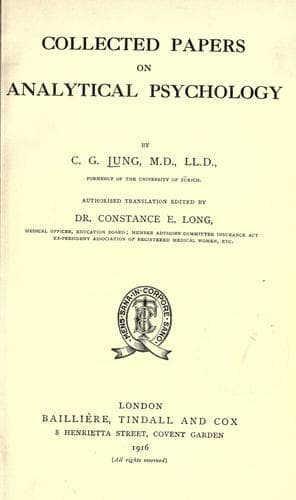
Collected Papers on Analytical PsychologyJung, C. G. (Carl Gustav)
Science
Collected Papers on Analytical Psychology
Jung, C. G. (Carl Gustav)
Psychoanalysis
The constructive standpoint is different. Here the delusional system
is neither infantile nor, upon the whole, _eo ipso_ pathological but
_subjective_, and hence justified within the scope of the subjective.
The constructive standpoint absolutely denies the conception that the
subjective phantasy-creation is merely an infantile wish, symbolically
veiled; or that it is merely that in a higher degree; it denies that
it is a convulsive and egoistic adhesion to the fiction of its own
superiority, in so far as these are to be regarded as finalistic
explanations. The subjective activity of the mind can be judged from
without, just as one can, in the end, so judge everything. But this
judgment is inadequate, because it is the very essence of the subjective
that it cannot be judged objectively. We cannot measure distance in
pints. The subjective can be only understood and judged subjectively,
that is, constructively. Any other judgment is unfair and does not meet
the question.
The absolute credit which the constructive standpoint confers upon the
subjective, naturally seems to the "scientific" spirit as an utter
violation of reason. But this scientific spirit can only take up arms
against it so long as the constructive is not avowedly _subjective_. The
constructive comprehension also _analyses_, but it does not _reduce_.
It decomposes the delusion into _typical_ components. What is to be
regarded as the type at a given time is shown from the attainment of
experience and knowledge reached at that time.
Even the most individual delusional systems are not absolutely unique,
occurring only once, for they offer striking and obvious analogies
with other systems. From the comparative analysis of many systems
the typical formations are drawn. If one can speak of reduction at
all, it is only a question of reduction to general type, but not to
some universal principle obtained inductively or deductively, such
as "Sexuality" or "Struggle for Power." This paralleling with other
typical formations only serves for a widening of the basis upon which
the construction is to be built. If one were to proceed entirely
subjectively one would go on constructing in the language of the patient
and in his mental range. One would arrive at some structure which was
illuminating to the patient and to the investigator of the case but not
to the outer scientific public. The public would be unable to enter into
the peculiarities of the speech and thought of the individual case in
question without further help.
Public-domain text, read in full here on John Shaqi.
Reviews
Reviews
No reviews yet
Be the first to share your thoughts on this work.
Elsewhere in the archive
Join the Discussion
Join the discussion
Sign in to leave a comment or review.
Sign InorCreate an account