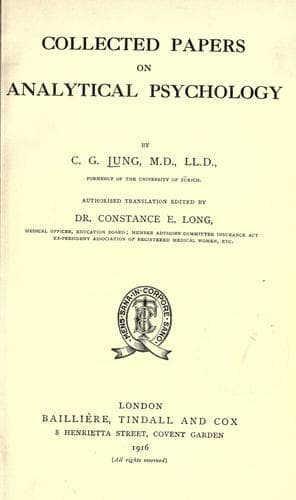
Collected Papers on Analytical PsychologyJung, C. G. (Carl Gustav)
Science
Collected Papers on Analytical Psychology
Jung, C. G. (Carl Gustav)
Psychoanalysis
Perhaps after all the real benefactors of mankind
are its false teachers, for opposition to the false doctrine pushes men
willy nilly into truth. Your truth-teller is a pernicious fellow, he
drives men into error."
The reader must now calmly accept the idea that in this psychology
he is dealing with something quite unique, if not indeed with some
altogether irrational, sectarian, or occult wisdom; for what else could
possibly provoke all the scientific authorities to turn away on the very
threshold and utterly refuse to cross it?
Accordingly, we must look more closely into this psychology. As long
ago as Charcot's time it was recognised that neurotic symptoms are
"psychogenic," that is, that they have their origin in the psyche.
It was also known, thanks mainly to the work of the Nancy School,
that every hysterical symptom can be exactly reproduced by means of
suggestion. But _how_ a hysterical system arises, and its relationship
to psychic causes, were altogether unknown. In the beginning of the
eighties Dr. Breuer, an old Viennese doctor, made a discovery[222]
which was really the true starting-point of the new psychology.
He had a very intelligent young patient (a woman) suffering from
hysteria, who exhibited the following symptoms among others: A spastic
paralysis of the right arm, occasional disturbances of consciousness
or twilight-states, and loss of the power of speech in so far as she
no longer retained any knowledge of her mother-tongue, and could only
express herself in English (so-called systematic aphasia). They sought
at that time, and still seek, in such a case to establish some theory of
anatomical disturbance, although there was just as little disturbance
in the arm-centre in the brain as in that of any normal man who boxes
another's ears. The symptomatology of hysteria is full of anatomical
impossibilities; such as the case of the lady who had lost her hearing
completely through some hysterical malady. None the less she often used
to sing, and once when she was singing her doctor sat down at the piano
unnoticed by her and softly accompanied her. Passing from one strophe
to another he suddenly altered the key, and she, quite unconscious of
what she was doing, sang on in the altered key. Thus she heard--yet did
not hear. The various forms of systematic blindness present similar
phenomena. We have the case of a man suffering from complete hysterical
blindness. In the course of the treatment he recovers his sight, but at
first, and for some long time, only partially: he could see everything
with one exception--people's heads. He saw all the people around him
without heads. Thus he saw--yet did not see. From a large number of like
experiences it has long been concluded that it is only the patient's
consciousness which does not see, does not hear, but the sense-function
has nothing at all the matter with it. This state of affairs is directly
contradictory to the essence of an organic disturbance, which always
Public-domain text, read in full here on John Shaqi.
Reviews
Reviews
No reviews yet
Be the first to share your thoughts on this work.
Elsewhere in the archive
Join the Discussion
Join the discussion
Sign in to leave a comment or review.
Sign InorCreate an account