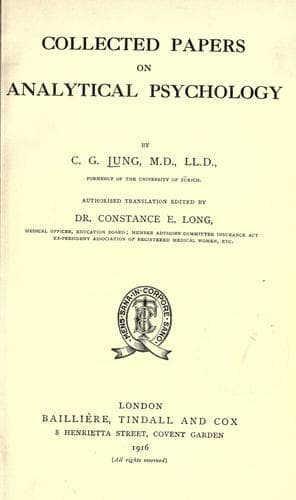
Collected Papers on Analytical PsychologyJung, C. G. (Carl Gustav)
Science
Collected Papers on Analytical Psychology
Jung, C. G. (Carl Gustav)
Psychoanalysis
This need became the starting-point of a new psychology whose inception
we owe first and foremost to the genius of Sigmund Freud, of Vienna,
to his researches into functional nervous disease. The new type of
psychology might be described as "analytical psychology." Professor
Bleuler has coined the name "Deep Psychology,"[217] to indicate that
the Freudian psychology takes as its province the deeper regions, the
"hinterland" of the soul, the "unconscious." Freud names his method of
investigation "psychoanalysis."
Before we approach the matter more closely, we must first consider the
relationship of the new psychology to the earlier science. Here we
encounter a singular little farce which once again proves the truth of
Anatole France's apothegm: "Les savants ne sont pas curieux."
The first important piece of work[218] in this new field awakened
only the faintest echo, in spite of the fact that it offered a new
and fundamental conception of the neuroses. Certain writers expressed
their approbation, and then, on the next page, proceeded to explain
their cases of hysteria in the good old way. It was much as if a man
should subscribe fully to the idea of the earth's being spherical, and
yet continue to represent it as flat. Freud's next publications[219]
were practically unnoticed, although they contributed findings of
immeasurable importance to the domain of psychiatry. When in 1900 he
produced the first real psychological elucidation of the dream[220]
(previously there had reigned over this territory a suitable nocturnal
darkness), he was ridiculed; and when in the middle of the last decade
he began to illumine the psychology of sexuality itself,[221] and at
the same time the "Zürich school" decided to range itself on his side,
a storm of abuse, sometimes of the coarsest kind, burst upon him, nor
has it yet ceased to rage. At the last South-West German Congress of
alienists in Baden-Baden, the adherents of the new psychology had
the pleasure of hearing Hoche, University Professor of Psychiatry at
Freiburg in Breisgau, describe the movement in a long and much-applauded
address, as an outbreak of mental aberration _among doctors_. The old
proverb: "Medicus medicum non decimat" was here quite put to shame. How
carefully the question had been studied was shewn by the naïve remark
of one of the most distinguished neurologists of Paris, which I myself
heard at the International Congress in 1907: "It is true I have not
read Freud's works (he did not happen to know any German!), but as for
his theories, they are nothing but a "mauvaise plaisanterie." Freud,
dignified, masterly, once said to me, I first became clearly conscious
of the value of my discoveries when they were met everywhere with
resistance and anger; since that time I have judged the value of my work
according to the degree of opposition provoked. It is against my sexual
theory that the greatest indignation is felt, so it would seem therein
lies my best work.
Public-domain text, read in full here on John Shaqi.
Reviews
Reviews
No reviews yet
Be the first to share your thoughts on this work.
Elsewhere in the archive
Join the Discussion
Join the discussion
Sign in to leave a comment or review.
Sign InorCreate an account