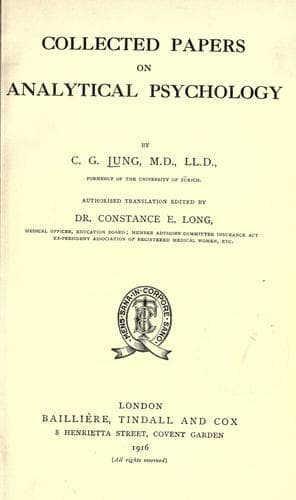
Collected Papers on Analytical PsychologyJung, C. G. (Carl Gustav)
Science
Collected Papers on Analytical Psychology
Jung, C. G. (Carl Gustav)
Psychoanalysis
An apparently healthy young lady suddenly fell into an abnormally long
and deep sleep--it is said without prodromal symptoms. On awaking she
had forgotten the words for and the knowledge of the simplest things.
She had again to learn to read, write, and count; her progress was rapid
in this re-learning. After a second attack she again woke in her normal
state, but without recollection of the period when she had forgotten
things. These states alternated for more than four years, during which
consciousness showed continuity within the two states, but was separated
by an amnesia from the consciousness of the normal state.
These selected cases of various forms of changes of consciousness
all throw a certain light upon our case. Naef's case presents two
hysteriform eclipses of memory, one of which is marked by the appearance
of delusions, and the other by its long duration, contraction of the
field of consciousness, and desire to wander. The peculiar associated
impulses are specially clear in the cases of Proust and Mesnet. In our
case the impulsive tearing up of the flowers, the digging up of the
graves, form a parallel. The continuity of consciousness which the
patient presents in the individual attacks recalls the behaviour of
the consciousness in MacNish's case; hence our case may be regarded
as a transient phenomenon of alternating consciousness. The dreamlike
hallucinatory content of the limited consciousness in our case does not,
however, justify an unqualified assignment to this group of _double
consciousness_. The hallucinations in the second state show a certain
creativeness which seems to be conditioned by the auto-suggestibility
of this state. In Mesnet's case we noticed the appearance of
hallucinatory processes from simple stimulation of touch. The patient's
subconsciousness employs simple perceptions for the automatic
construction of complicated scenes which then take possession of the
limited consciousness. A somewhat similar view must be taken about
our patient's hallucinations; at least, the external conditions which
gave rise to the appearance of the hallucinations seem to strengthen
our supposition. The walk in the cemetery induces the vision of the
skeletons; the meeting with the three boys arouses the hallucination of
children buried alive whose voices the patient hears at night-time. She
arrived at the cemetery in a somnambulic state, which on this occasion
was specially intense in consequence of her having taken alcohol. She
performed actions almost instinctively about which her subconsciousness
nevertheless did receive certain impressions. (The part played here by
alcohol must not be underestimated. We know from experience that it does
not only act adversely upon these conditions, but, like every other
narcotic, it gives rise to a certain increase of suggestibility.) The
impressions received in somnambulism subconsciously form independent
growths, and finally reach perception as hallucinations. Thus our
Public-domain text, read in full here on John Shaqi.
Reviews
Reviews
No reviews yet
Be the first to share your thoughts on this work.
Join the Discussion
Join the discussion
Sign in to leave a comment or review.
Sign InorCreate an account