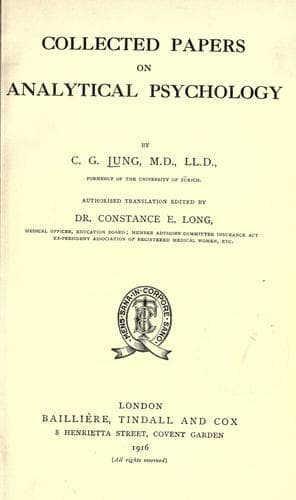
Collected Papers on Analytical Psychology — John Shaqi
Collected Papers on Analytical PsychologyJung, C. G. (Carl Gustav)
Science
Collected Papers on Analytical Psychology
Jung, C. G. (Carl Gustav)
Psychoanalysis
She is fully orientated to the external world, but seems to stand
with one foot, as it were, in her dream-world. She sees and hears her
spirits, sees how they walk about in the room among those who form
the circle, and stand first by one person, then by another. She is in
possession of a clear remembrance of her visions, her journeys and the
instructions she receives. She speaks quietly, clearly and firmly and
is always in a serious, almost religious frame of mind. Her bearing
indicates a deeply religious mood, free from all pietistic flavour, her
speech is singularly uninfluenced by her guide's jargon compounded of
Bible and tract. Her solemn behaviour has a suffering, rather pitiful
aspect. She is painfully conscious of the great differences between
her ideal world at night and the rough reality of the day. This state
stands in sharp contrast to her waking existence; there is here no
trace of that unstable and inharmonious creature, that extravagant
nervous temperament which is so characteristic for the rest of her
relationships. Speaking with her, you get the impression of speaking
with a much older person who has attained through numerous experiences
to a sure harmonious footing. In this state she produced her best
results, whilst her romances correspond more closely to the conditions
of her waking interests. The semi-somnambulism usually appears
spontaneously, mostly during the table experiments, which sometimes
announced by this means that S. W. was beginning to know beforehand
every automatic communication from the table. She then usually stopped
the table-turning and after a short time passed more or less suddenly
into an ecstatic state. S. W. showed herself to be very sensitive. She
could divine and reply to simple questions thought of by a member of the
circle who was not a "medium," if only the latter would lay a hand on
the table or on her hand. Genuine thought-transference without direct
or indirect contact could never be achieved. In juxtaposition with the
obvious development of her whole personality the continued existence of
her earlier ordinary character was all the more startling. She imparted
with unconcealed pleasure all the little childish experiences, the
flirtations and love-secrets, all the rudeness and lack of education
of her parents and contemporaries. To every one who did not know her
secret she was a girl of fifteen and a half, in no respect unlike a
thousand other such girls. So much the greater was people's astonishment
when they got to know her in her other aspect. Her near relatives could
not at first grasp this change: to some extent they never altogether
understood it, so there was often bitter strife in the family, some of
them taking sides for and others against S. W., either with enthusiastic
over-valuation or with contemptuous censure of "superstition." Thus
did S. W., during the time I watched her closely, lead a curious,
contradictory life, a real "double life" with two personalities existing
Public-domain text, read in full here on John Shaqi.
Reviews
Reviews
No reviews yet
Be the first to share your thoughts on this work.
Join the Discussion
Join the discussion
Sign in to leave a comment or review.
Sign InorCreate an account