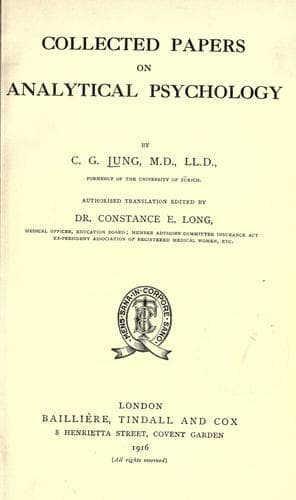
Collected Papers on Analytical PsychologyJung, C. G. (Carl Gustav)
Science
Collected Papers on Analytical Psychology
Jung, C. G. (Carl Gustav)
Psychoanalysis
Since convinced spiritualists took part in the séances, all kinds
of spiritualistic wonders were of course demanded, and especially
the "protecting spirits." In reply, sometimes names of well-known
dead people were produced, sometimes unknown names, _e.g._ Berthe
de Valours, Elizabeth von Thierfelsenburg, Ulrich von Gerbenstein,
etc. The controlling spirit was almost without exception the medium's
grandfather, who once explained: "he loved her more than any one in
this world because he had protected her from childhood up, and knew
all her thoughts." This personality produced a flood of Biblical
maxims, edifying observations, and song-book verses; the following is a
specimen:--
In true believing,
To faith in God cling ever nigh,
Thy heavenly comfort never leaving,
Which having, man can never die.
Refuge in God is peace for ever,
When earthly cares oppress the mind;
Who from the heart can pray is never
Bowed down by fate, howe'er unkind.
Numerous similar elaborations betrayed by their banal, unctuous
contents their origin in some tract or other. When S. W. had to speak
in ecstasy, lively dialogues developed between the circle-members and
the somnambulic personality. The content of the answers received is
essentially just the same commonplace edifying stuff as that of the
psychographic communications. The character of this personality is
distinguished by its dry and tedious solemnity, rigorous conventionality
and pietistic virtue (which is not consistent with the historic
reality). The grandfather is the medium's guide and protector. During
the ecstatic state he gives all kinds of advice, prophesies later
attacks and the visions she will see on waking, etc. He orders cold
bandages, gives directions concerning the medium's lying down or the
date of the séances. His relationship to the medium is an extremely
tender one. In liveliest contrast to this heavy dream-person stands
a personality, appearing first sporadically, in the psychographic
communications of the first séance. It soon disclosed itself as the
dead brother of a Mr. R., who was then taking part in the séance. This
dead brother, Mr. P. R., was full of commonplaces about brotherly love
towards his living brother. He evaded particular questions in all
manner of ways. But he developed a quite astonishing eloquence towards
the ladies of the circle and in particular offered his allegiance to
one whom Mr. P. R. had never known when alive. He affirmed that he
had already cared very much for her in his lifetime, had often met
her in the street without knowing who she was, and was now uncommonly
delighted to become acquainted with her in this unusual manner. With
such insipid compliments, scornful remarks to the men, harmless childish
jokes, etc., he took up a large part of the séance. Several of the
members found fault with the frivolity and banality of this "spirit,"
whereupon he disappeared for one or two séances, but soon reappeared,
Public-domain text, read in full here on John Shaqi.
Reviews
Reviews
No reviews yet
Be the first to share your thoughts on this work.
Join the Discussion
Join the discussion
Sign in to leave a comment or review.
Sign InorCreate an account