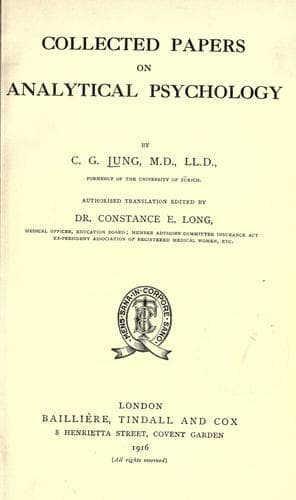
Collected Papers on Analytical Psychology — John Shaqi
Collected Papers on Analytical PsychologyJung, C. G. (Carl Gustav)
Science
Collected Papers on Analytical Psychology
Jung, C. G. (Carl Gustav)
Psychoanalysis
In semi-somnambulism S. W. gave some of those taking part in the
séances the opportunity to compare her with the "Seherin von Prevorst"
(Prophetess of Prevorst). This suggestion was not without results.
S. W. gave hints of earlier existences which she had already lived
through, and after a few weeks she suddenly disclosed a whole system of
reincarnations, although she had never before mentioned anything of the
kind. Ivenes is a spiritual being who is something more than the spirits
of other human beings. Every human spirit must incorporate himself
twice in the course of the centuries. But Ivenes must incorporate
herself at least once every two hundred years; besides herself only two
other persons have participated in this fate, namely, Swedenborg and
Miss Florence Cook (Crookes's famous medium). S. W. calls these two
personages her brother and sister. She gave no information about their
pre-existences. In the beginning of the nineteenth century Ivenes was
Frau Hauffe, the Prophetess of Prevorst; at the end of the eighteenth
century, a clergyman's wife in central Germany (locality unknown).
As the latter she was seduced by Goethe and bore him a child. In the
fifteenth century she was a Saxon countess, and had the poetic name of
Thierfelsenburg. Ulrich von Gerbenstein is a relative from that line.
The interval of 300 years, and her adventure with Goethe, must be atoned
for by the sorrows of the Prophetess of Prevorst. In the thirteenth
century she was a noblewoman of Southern France, called de Valours,
and was burnt as a witch. From the thirteenth century to the Christian
persecution under Nero there were numerous reincarnations of which S.
W. could give no detailed account. In the Christian persecution under
Nero she played a martyr's part. Then comes a period of obscurity till
the time of David, when Ivenes was an ordinary Jewess. After her death
she received from Astaf, an angel from a high heaven, the mandate for
her future wonderful career. In all her pre-existences she was a medium
and an intermediary in the intercourse between this side and the other.
Her brothers and sisters are equally old and have the like vocation. In
her various pre-existences she was sometimes married, and in this way
gradually founded a whole system of relationships with whose endless
complicated inter-relations she occupied herself in many ecstasies.
Thus, for example, about the eighth century she was the mother of her
earthly father and, moreover, of her grandfather, and mine. Hence the
striking friendship of these two old gentlemen, otherwise strangers. As
Mme. de Valours she was the present writer's mother. When she was burnt
as a witch the writer took it much to heart, and went into a cloister
at Rouen, wore a grey habit, became Prior, wrote a work on Botany and
died at over eighty years of age. In the refectory of the cloister
there hung a picture of Mme. de Valours, in which she was depicted in
a half-reclining position. (S. W.
Public-domain text, read in full here on John Shaqi.
Reviews
Reviews
No reviews yet
Be the first to share your thoughts on this work.
Join the Discussion
Join the discussion
Sign in to leave a comment or review.
Sign InorCreate an account