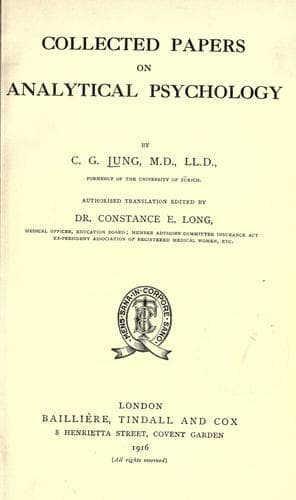
Collected Papers on Analytical PsychologyJung, C. G. (Carl Gustav)
Science
Collected Papers on Analytical Psychology
Jung, C. G. (Carl Gustav)
Psychoanalysis
At all times the complex hallucinations of visionaries have occupied
a peculiar place in scientific criticism. Macario[54] early separated
these so-called intuition-hallucinations from others, since he maintains
that they occur in persons of an eager mind, deep understanding and high
nervous excitability. Hecker[55] expresses himself similarly but more
enthusiastically.
His view is that their condition is "the congenital high development
of the spiritual organ which calls into active, free and mobile play
the life of the imagination, bringing it spontaneous activity." These
hallucinations are "precursors or signs of mighty spiritual power." The
vision is "an increased excitation which is harmoniously adapted to
the most complete health of mind and body." The complex hallucinations
do not belong to the waking state, but prefer as a rule a partial
waking state. The visionary is buried in his vision even to complete
annihilation. Flournoy was also always able to prove in the visions
of H.S. "un certain degré d'obnubilation." In our case the vision is
complicated by a state of sleep whose peculiarities we shall review
later.
THE CHANGE IN CHARACTER.
The most striking characteristic of the second stage in our case is the
change in character. We meet many cases in the literature which have
offered the symptom of spontaneous character-change. The first case in a
scientific publication is Weir-Mitchell's[56] case of Mary Reynolds.
This was the case of a young woman living in Pennsylvania in 1811.
After a deep sleep of about twenty hours she had totally forgotten her
entire past and everything she had learnt; even the words she spoke
had lost their meaning. She no longer knew her relatives. Slowly she
re-learnt to read and write, but her writing was from right to left.
More striking still was the change in her character. Instead of being
melancholy, she was now cheerful in the extreme. Instead of being
reserved, she was buoyant and sociable. Formerly taciturn and retiring,
she was now merry and jocose. Her disposition was totally changed.[57]
In this state she renounced her former retired life and liked to
undertake adventurous excursions unarmed, through wood and mountain, on
foot and horseback. In one of these excursions she encountered a large
black bear, which she took for a pig. The bear raised himself on his
hind legs and gnashed his teeth at her. As she could not drive her horse
on any further, she took an ordinary stick and hit the bear until it
took to flight. Five weeks later, after a deep sleep, she returned to
her earlier state with amnesia for the interval. These states alternated
for about sixteen years. _But her last twenty-five years Mary Reynolds
passed exclusively in her second state._
Public-domain text, read in full here on John Shaqi.
Reviews
Reviews
No reviews yet
Be the first to share your thoughts on this work.
Elsewhere in the archive
Join the Discussion
Join the discussion
Sign in to leave a comment or review.
Sign InorCreate an account