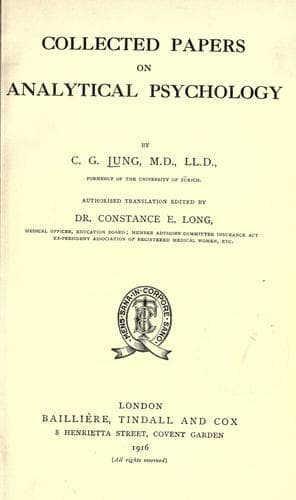
Collected Papers on Analytical PsychologyJung, C. G. (Carl Gustav)
Science
Collected Papers on Analytical Psychology
Jung, C. G. (Carl Gustav)
Psychoanalysis
Schroeder von der Kalk[58] reports on the following case: The patient
became ill at the age of sixteen with periodic amnesia, after a previous
tedious illness of three years. Sometimes in the morning after waking
she passed through a peculiar choreic state, during which she made
rhythmical movements with her arms. Throughout the whole day she would
then exhibit a childish, silly behaviour and lost all her educated
capabilities. (When normal she is very intelligent, well-read, speaks
French well.) In the second state she begins to speak faulty French.
On the second day she is again at times normal. The two states are
completely separated by amnesia.[59]
Hoefelt[60] reports on a case of spontaneous somnambulism in a girl who,
in her normal state, was submissive and modest, but in somnambulism was
impertinent, rude and violent. Azam's[61] Felida was, in her normal
state, depressed, inhibited, timid; and in the second state lively,
confident, enterprising to recklessness. _The second state gradually
became the chief one, and finally so far suppressed the first state
that the patient called her normal states, lasting now but a short
time, "crises."_ The amnesic attacks had begun at 14 1/2. In time the
second state became milder and there was a certain approximation between
the character of the two states. A very striking example of change in
character is that worked out by Camuset, Ribot, Legrand du Saulle,
Richer, Voisin, and put together by Bourru and Burot.[62] It is that of
Louis V., a severe male hysteric with amnesic alternating character.
In the first stage he is rude, cheeky, querulous, greedy, thievish,
inconsiderate. In the second state he is an agreeable, sympathetic
character, industrious, docile and obedient. This amnesic change of
character has been used by Paul Lindau[63] in his drama "Der Andere"
(The Other One).
Rieger[64] reports on a case parallel to Lindau's criminal lawyer. The
unconscious personalities of Janet's Lucie and Léonie (Janet, _l.c._)
and Morton Prince's[65] may also be regarded as parallel with our case.
There are, however, therapeutic artificial products whose importance
lies in the domain of the dissociation of consciousness and of memory.
In the above cases, the second state is always separated from the first
by an amnesic dissociation, and the change in character is, at times,
accompanied by a break in the continuity of consciousness. In our case
there is no amnesic disturbance; the passage from the first to the
second stage follows quite gradually and the continuity of consciousness
remains. The patient carries out in her waking state everything,
otherwise unknown to her, from the field of the unconscious that she has
experienced during hallucinations in the second stage.
Public-domain text, read in full here on John Shaqi.
Reviews
Reviews
No reviews yet
Be the first to share your thoughts on this work.
Elsewhere in the archive
Join the Discussion
Join the discussion
Sign in to leave a comment or review.
Sign InorCreate an account