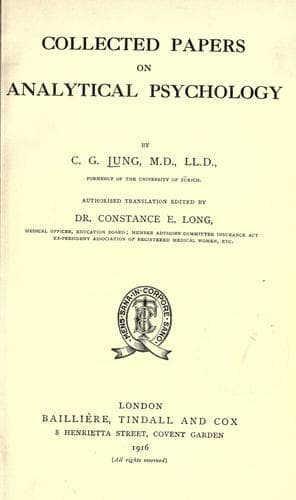
Collected Papers on Analytical PsychologyJung, C. G. (Carl Gustav)
Science
Collected Papers on Analytical Psychology
Jung, C. G. (Carl Gustav)
Psychoanalysis
Periodic changes in personality without amnesic dissociation are found
in the region of _folie circulaire_, but are rarely seen in hysterics,
as Renaudin's[66] case shows. A young man, whose behaviour had always
been excellent, suddenly began to display the worst tendencies. There
were no symptoms of insanity, but, on the other hand, the whole surface
of the body was anæsthetic. This state showed periodic intervals, and
in the same way the patient's character was subject to vacillations. As
soon as the anæsthesia disappeared he was manageable and friendly. When
the anæsthesia returned he was overcome by the worst instincts, which,
it was observed, even included the wish to murder.
Remembering that our patient's age at the beginning of the disturbances
was 14 1/2, that is, the age of puberty had just been reached, one
must suppose that there was some connection between the disturbances
and the physiological character-changes at puberty. "There appears
in the consciousness of the individual during this period of life a
new group of sensations, together with the feelings and ideas arising
therefrom; this continuous pressure of unaccustomed mental states makes
itself constantly felt because the cause is always at work; the states
are co-ordinated because they arise from one and the same source, and
must little by little bring about deep-seated changes in the ego."[67]
Vacillating moods are easily recognisable; the confused new, strong
feelings, the inclination towards idealism, to exalted religiosity
and mysticism, side by side with the falling back into childishness,
all this gives to adolescence its prevailing character. At this epoch
the human being first makes clumsy attempts at independence in every
direction; for the first time uses for his own purposes all that family
and school have contributed hitherto; he conceives ideals, constructs
far-reaching plans for the future, lives in dreams whose content is
ambitious and egotistic. This is all physiological. The puberty of
a psychopathic is a crisis of more serious import. Not only do the
psychophysical changes run a stormy course, but features of a hereditary
degenerate character become fixed. In the child these do not appear at
all, or but sporadically. For the explanation of our case we are bound
to consider a specific disturbance of puberty. The reasons for this
view will appear from a further study of the second personality. (For
the sake of brevity we shall call the second personality IVENES--as the
patient baptised her higher ego).
Public-domain text, read in full here on John Shaqi.
Reviews
Reviews
No reviews yet
Be the first to share your thoughts on this work.
Elsewhere in the archive
Join the Discussion
Join the discussion
Sign in to leave a comment or review.
Sign InorCreate an account