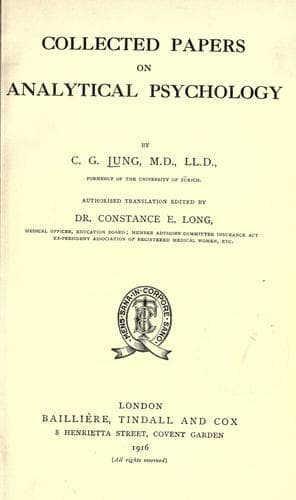
Collected Papers on Analytical PsychologyJung, C. G. (Carl Gustav)
Science
Collected Papers on Analytical Psychology
Jung, C. G. (Carl Gustav)
Psychoanalysis
Ivenes is just the continuation of the waking self. She contains
the entire consciousness of S. W.'s waking state. Her remarkable
behaviour tells decidedly against any analogy with cases of _double
consciousness_. The characteristics of Ivenes contrast favourably with
the patient's ordinary self. She is a calmer, more composed personality;
her pleasing modesty and accuracy, her uniform intelligence, her
confident way of talking must be regarded as an improvement of the whole
being; thus far there is analogy with Janet's Léonie. But this is the
extent of the similarity. Apart from the amnesia, they are divided by
a deep psychological difference. Léonie II. is the healthier, the more
normal; she has regained her natural capabilities, she shows remarkable
improvement upon her chronic condition of hysteria. Ivenes rather gives
the impression of a more artificial product; there is something thought
out; despite all her excellences she gives the impression of playing
a part excellently; her world-sorrow, her yearning for the other side
of things, are not merely piety but the attributes of saintliness.
Ivenes is no mere human, but a mystic being who only partly belongs to
reality. The mournful features, the attachment to sorrow, her mysterious
fate, lead us to the historic prototype of Ivenes--Justinus Kerner's
"Prophetess of Prevorst." Kerner's book must be taken as known, and
therefore I omit any references to these common traits. But Ivenes is
no copy of the prophetess; she lacks the resignation and the saintly
piety of the latter. The prophetess is merely used by her as a study
for her own original conception. The patient pours her own soul into
the _rôle_ of the prophetess, thus seeking to create an ideal of virtue
and perfection. She anticipates her future. She incarnates in Ivenes
what she wishes to be in twenty years--the assured, influential, wise,
gracious, pious lady. It is in the construction of the second person
that there lies the far-reaching difference between Léonie II. and
Ivenes. Both are psychogenic. But Léonie I. receives in Léonie II. what
really belongs to her, while S. W. builds up a person beyond herself.
It cannot be said "she deceives herself" into, but that "she dreams
herself" into the higher ideal state.[69]
Public-domain text, read in full here on John Shaqi.
Reviews
Reviews
No reviews yet
Be the first to share your thoughts on this work.
Elsewhere in the archive
Join the Discussion
Join the discussion
Sign in to leave a comment or review.
Sign InorCreate an account