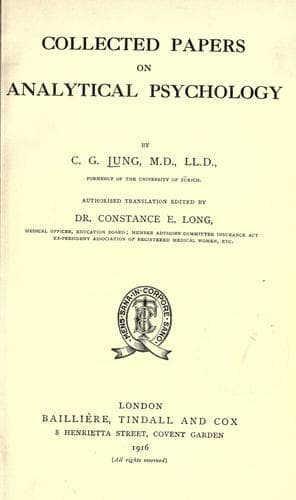
Collected Papers on Analytical PsychologyJung, C. G. (Carl Gustav)
Science
Collected Papers on Analytical Psychology
Jung, C. G. (Carl Gustav)
Psychoanalysis
The realisation of this dream recalls vividly the psychology of the
pathological cheat. Delbruck[70] and Forel[71] have indicated the
importance of auto-suggestion in the formation of pathological cheating
and reverie. Pick[72] regards intense auto-suggestibility as the first
symptom of the hysterical dreamer, making possible the realisation of
the "day-dream." One of Pick's patients dreamt that she was in a morally
dangerous situation, and finally carried out an attempt at rape on
herself; she lay on the floor naked and fastened herself to a table and
chairs. Or some dramatic person will be created with whom the patient
enters into correspondence by letter, as in Bohn's case.[73] The patient
dreamt herself into an engagement with a totally imaginary lawyer in
Nice, from whom she received letters which she had herself written in
disguised handwriting. This pathological dreaming, with auto-suggestive
deceptions of memory amounting to real delusions and hallucinations, is
pre-eminently to be found in the lives of many saints.[74]
It is only a step from the dreamlike images strongly stamped by the
senses to the true complex hallucinations.[75] In Pick's case, for
instance, one sees that the patient, who persuades herself that she is
the Empress Elizabeth, gradually loses herself in her dreams to such an
extent that her condition must be regarded as a true "twilight" state.
Later it passes over into hysterical delirium, when her dream-phantasies
become typical hallucinations. The pathological liar, who becomes
involved through his phantasies, behaves exactly like a child who
loses himself in his play, or like the actor who loses himself in his
part.[76] There is here no fundamental distinction from somnambulic
dissociation of personality, but only a difference of degree, which
rests upon the intensity of the primary auto-suggestibility or
disintegration of the psychic elements. _The more consciousness becomes
dissociated, the greater becomes the plasticity of the dream situation,
the less becomes the amount of conscious lying and of consciousness in
general._ This being carried away by interest in the object is what
Freud calls _hysterical identification_. For instance, to Erler's[77]
acutely hysterical patient there appeared hypnagogically little riders
made of paper, who so took possession of her imagination that she had
the feeling of being herself one of them. Similar phenomena normally
occur to us in dreams in general, in which we think like "hysterics."[78]
The complete abandonment to the interesting image explains also the
wonderful naturalness of pseudological or somnambulic representation--a
degree unattainable in conscious acting. The less waking consciousness
intervenes by reflection and reasoning, the more certain and convincing
becomes the objectivation of the dream, e.g. the roof-climbing of
somnambulists.
Public-domain text, read in full here on John Shaqi.
Reviews
Reviews
No reviews yet
Be the first to share your thoughts on this work.
Elsewhere in the archive
Join the Discussion
Join the discussion
Sign in to leave a comment or review.
Sign InorCreate an account