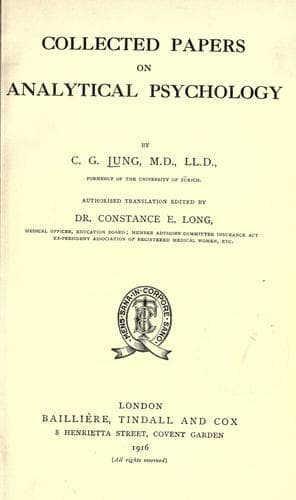
Collected Papers on Analytical PsychologyJung, C. G. (Carl Gustav)
Science
Collected Papers on Analytical Psychology
Jung, C. G. (Carl Gustav)
Psychoanalysis
In this way we may explain the apparently sudden and direct appearance
of dream-states. The entire carrying over of the conscious personality
into the dream-_rôle_ involves indirectly the development of
simultaneous automatisms. "Une seconde condition peut amener la division
de conscience; ce n'est pas une altération de la sensibilité, c'est
une attitude particulière de l'esprit, la concentration de l'attention
pour un point unique; il résulte de cet état de concentration que
l'esprit devient distrait pour la reste et en quelque sorte insensible,
ce qui ouvre la carrière aux actions automatiques, et ces actions
peuvent prendre un caractère psychique et constituer des intelligences
parasites, vivant côte à côte avec la personnalité normale qui ne les
connaît pas."[83]
Our subject's romances throw a most significant light on the subjective
roots of her dreams. They swarm with secret and open love-affairs,
with illegitimate births and other sexual insinuations. The central
point of all these ambiguous stories is a lady whom she dislikes, who
is gradually made to assume the form of her polar opposite, and whilst
Ivenes becomes the pinnacle of virtue, this lady is a sink of iniquity.
_But her reincarnation doctrines, in which she appears as the mother
of countless thousands, arises in its naïve nakedness from an exuberant
phantasy which is, of course, very characteristic of the period of
puberty. It is the woman's premonition of the sexual feeling, the dream
of fruitfulness, which the patient has turned into these monstrous
ideas._ We shall not go wrong if we seek for the curious form of the
disease in the teeming sexuality of this too-rich soil. Viewed from this
standpoint, the whole creation of Ivenes, with her enormous family, is
nothing but a dream of sexual wish-fulfilment, differentiated from the
dream of a night only in that it persists for months and years.
RELATION TO THE HYSTERICAL ATTACK.
So far one point in S. W.'s history has remained unexplained, and
that is her attack. In the second séance she was suddenly seized with
a sort of fainting fit, from which she awoke with a recollection of
various hallucinations. According to her own statement, she had not lost
consciousness for a moment. Judging from the external symptoms and the
course of the attack, one is inclined to regard it as a _narcolepsy_,
or rather a _lethargy_; such, for example, as Loewenfeld has described,
and the more readily as we know that previously one member of her family
(her grandmother) has had an attack of lethargy. It is possible to
imagine that the _lethargic disposition_ (Loewenfeld) had descended to
our subject. In spiritualistic séances it is not usual to see hysterical
convulsions. Our subject showed no sort of convulsive symptoms, but in
their place, perhaps, the peculiar sleeping-states. Ætiologically, at
the outset, two moments must be taken into consideration:
1. The irruption of hypnosis.
2. The psychic stimulation.
Public-domain text, read in full here on John Shaqi.
Reviews
Reviews
No reviews yet
Be the first to share your thoughts on this work.
Elsewhere in the archive
Join the Discussion
Join the discussion
Sign in to leave a comment or review.
Sign InorCreate an account