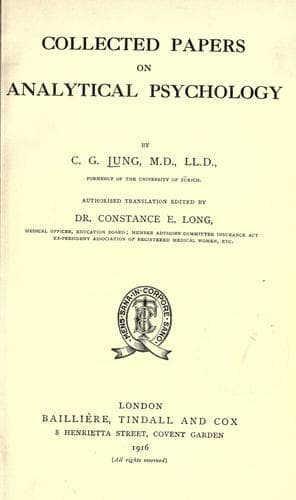
Collected Papers on Analytical PsychologyJung, C. G. (Carl Gustav)
Science
Collected Papers on Analytical Psychology
Jung, C. G. (Carl Gustav)
Psychoanalysis
Our case has another analogy with _pseudologia phantastica_: _The
development of the phantasies during the attacks._ Many cases are known
in the literature where the pathological lying comes on in attacks and
during serious hysterical trouble.[79]
Our patient develops her systems exclusively in the attack. In her normal
state she is quite incapable of giving any new ideas or explanations;
she must either transpose herself into somnambulism or await its
spontaneous appearance. This exhausts the affinity to _pseudologia
phantastica_ and to pathological dream-states.
Our patient's state is even differentiated from pathological dreaming,
since it could never be proved that her dream-weavings had at any
time previously been the objects of her interest during the day. Her
dreams occur explosively, break forth with bewildering completeness
from the darkness of the unconscious. Exactly the same was the case
in Flournoy's Helen Smith. In many cases (see below), however, links
with the perceptions of the normal states can be demonstrated: it seems
therefore probable that the roots of every dream were originally images
with an emotional accentuation, which, however, only occupied waking
consciousness for a short time.[80] We must allow that in the origin
of such dreams hysterical forgetfulness[81] plays a _part not to be
underestimated_.
Many images are buried which would be sufficient to put the
consciousness on guard; associated classes of ideas are lost and
go on spinning their web in the unconscious, thanks to the psychic
dissociation; this is a process which we meet again in the genesis of
our dreams.
"Our conscious reflection teaches us that when exercising attention we
pursue a definite course. But if that course leads us to an idea which
does not meet with our approval, we discontinue and cease to apply
our attention. Now, apparently, the chain of thought thus started and
abandoned, may go on without regaining attention unless it reaches a
spot of especially marked intensity, which compels renewed attention.
An initial rejection, perhaps consciously brought about by the judgment
on the ground of incorrectness or unfitness for the actual purpose of
the mental act, may therefore account for the fact that a mental process
continues unnoticed by consciousness until the onset of sleep."[82]
Public-domain text, read in full here on John Shaqi.
Reviews
Reviews
No reviews yet
Be the first to share your thoughts on this work.
Elsewhere in the archive
Join the Discussion
Join the discussion
Sign in to leave a comment or review.
Sign InorCreate an account