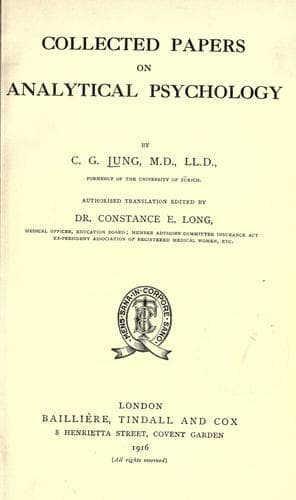
Collected Papers on Analytical PsychologyJung, C. G. (Carl Gustav)
Science
Collected Papers on Analytical Psychology
Jung, C. G. (Carl Gustav)
Psychoanalysis
In Bonamaison's[93] case not only was the sense of touch retained,
but the senses of hearing and smell were quickened. The hallucinatory
content and loud speaking is also met with in persons with
hallucinations in lethargy.[94] Usually there prevails total amnesia
for the lethargic interval. Loewenfeld's[95] case D. had, however,
a fleeting recollection; in Bonamaison's case there was no amnesia.
Lethargic patients do not prove susceptible to the usual waking stimuli,
but Loewenfeld succeeded with his patient St. in turning the lethargy
into hypnosis by means of mesmeric passes, thus combining it with the
rest of consciousness during the attack.[96] Our patient showed herself
absolutely insusceptible in the beginning of the lethargy, but later on
she began to speak spontaneously, was incapable of giving any attention
when her somnambulic ego was speaking, but could attend when it was
one of her automatic personalities. In this last case it is probable
that the hypnotic effect of the automatisms succeeded in achieving a
partial transformation of the lethargy into hypnosis. When we consider
that, according to Loewenfeld's view, the lethargic disposition must not
be "too readily identified with the peculiar condition of the nervous
apparatus in hysteria," then the idea of the family heredity of this
disposition in our case becomes not a little probable. The disease is
much complicated by these attacks.
So far we have seen that the patient's consciousness of her ego is
identical in all the states. We have discussed two secondary complexes
of consciousness and have followed them into the somnambulic attack,
where they appear as the patient's vision when she had lost her motor
activity during the attack. During the next attacks she was impervious
to any external incidents, but on the other hand developed, within
the twilight state, all the more intense activity, in the form of
visions. It seems that many secondary series of ideas must have split
off quite early from the primary unconscious personality, for already,
after the first two séances, "spirits" appeared by the dozen. The
names were inexhaustible in variety, but the differences between the
personalities were soon exhausted and it became apparent that they could
all be subsumed under two types, the _serio-religious_ type and the
_gay-hilarious_. So far it was really only a matter of _two different
unconscious personalities_, which appeared under different names but
had no essential differences. The older type, the grandfather, who
had initiated the automatisms, also first began to make use of the
twilight state. I am not able to remember any suggestion which might
have given rise to the automatic speaking. According to the preceding
view, the attack in such circumstances might be regarded as a partial
auto-hypnosis. The ego-consciousness which remains and, as a result of
its isolation from the external world, occupies itself entirely with
Public-domain text, read in full here on John Shaqi.
Reviews
Reviews
No reviews yet
Be the first to share your thoughts on this work.
Elsewhere in the archive
Join the Discussion
Join the discussion
Sign in to leave a comment or review.
Sign InorCreate an account