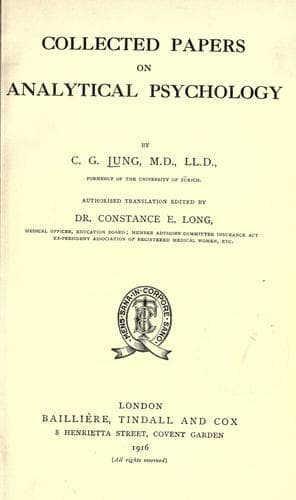
Collected Papers on Analytical PsychologyJung, C. G. (Carl Gustav)
Science
Collected Papers on Analytical Psychology
Jung, C. G. (Carl Gustav)
Psychoanalysis
its hallucinations, is what is left over of the waking consciousness.
Thus the automatism has a wide field for its activity. The independence
of the individual central spheres which we have proved at the beginning
to be present in the patient, makes the automatic act of speaking
appear intelligible. Just as the dreamer on occasion speaks in his
sleep, so, too, a man in his waking hours may accompany intensive
thought with an unconscious whisper.[97] The peculiar movements of the
speech-musculature are to be noted. They have also been observed in
other somnambulists.[98]
These clumsy attempts must be directly paralleled with the unintelligent
and clumsy movements of the table or glass, and most probably correspond
to the _preliminary activity_ of the motor portion of the presentation;
that is to say, a stimulus limited to the motor-centre which has not
previously been subordinated to any higher system. Whether the like
occurs in persons who talk in their dreams, I do not know. But it has
been observed in hypnotised persons.[99]
Since the convenient medium of speech was used as the means of
communication, the study of the subconscious personalities was
considerably lightened. Their intellectual compass is a relatively
mediocre one. Their knowledge is greater than that of the waking
patient, including also a few occasional details, such as the birthdays
of dead strangers and the like. The source of these is more or less
obscure, since the patient does not know whence in the ordinary way
she could have procured the knowledge of these facts. These are cases
of so-called cryptomnesia, which are too unimportant to deserve more
extended notice. The intelligence of the two subconscious persons is
very slight; they produce banalities almost exclusively, but their
relation to the conscious ego of the patient when in the somnambulic
state is interesting. They are invariably aware of everything that takes
place during ecstasy and occasionally they render an exact report from
minute to minute.[100]
The subconscious persons only know the patient's phantastic changes of
thought very superficially; they do not understand these and cannot
answer a single question concerning the situation. Their stereotyped
reference to Ivenes is: "Ask Ivenes." This observation reveals a dualism
in the character of the subconscious personalities difficult to explain;
for the grandfather, who gives information by automatic speech, also
appears to Ivenes and, according to her account, teaches her about the
objects in question. How is it that, when the grandfather speaks through
the patient's mouth, he knows nothing of the very things which he
himself teaches her in the ecstasies?
Public-domain text, read in full here on John Shaqi.
Reviews
Reviews
No reviews yet
Be the first to share your thoughts on this work.
Elsewhere in the archive
Join the Discussion
Join the discussion
Sign in to leave a comment or review.
Sign InorCreate an account