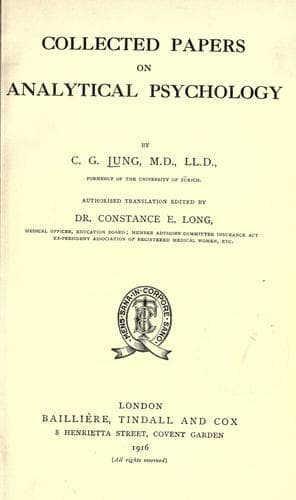
Collected Papers on Analytical PsychologyJung, C. G. (Carl Gustav)
Science
Collected Papers on Analytical Psychology
Jung, C. G. (Carl Gustav)
Psychoanalysis
We must again return to the discussion of the first appearance of the
hallucinations. We picture the vision, then, as an irruption of hypnosis
into the visual sphere. That irruption does not lead to a "normal"
hypnosis, but to a "hystero-hypnosis," that is, the simple hypnosis is
complicated by a hysterical attack.
It is not a rare occurrence in the domain of hypnotism for normal
hypnosis to be disturbed, or rather to be replaced by the unexpected
appearance of hysterical somnambulism; the hypnotist in many cases then
loses rapport with the patient. In our case the automatism arising in
the motor area plays the part of hypnotist; the suggestions proceeding
from it (called objective auto-suggestions) hypnotise the neighbouring
areas in which a certain susceptibility has arisen. At the moment
when the hypnotism flows over into the visual sphere, the hysterical
attack occurs which, as remarked, effects a very deep-reaching change
in a large portion of the psychical region. We must now suppose that
the automatism stands in the same relationship to the attack as the
hypnotist to a pathological hypnosis; its influence upon the further
structure of the situation is lost. The hallucinatory appearance of the
hypnotised personality, or rather of the suggested idea, may be regarded
as the last effect upon the somnambulic personality. Thenceforward the
hypnotist becomes only a figure with whom the somnambulic personality
occupies itself independently: he can only state what is going on and is
no longer the _conditio sine qua non_ of the content of the somnambulic
attack. The independent ego-complex of the attack, in our case Ivenes,
has now the upper hand. She groups her own mental products around
the personality of the hypnotiser, that is, of the grandfather, now
degraded to a mere image. In this way we are enabled to understand the
dualism in the character of the grandfather. _The grandfather I. who
speaks directly to those present, is a totally different person and a
mere spectator of his double, grandfather II., who appears as Ivenes'
teacher._ Grandfather I. maintains energetically that both are one and
the same person, and that I. has all the knowledge which II. possesses,
and is only prevented from giving information by the difficulties of
speech. (The dissociation was of course not realized by the patient,
who took both to be one person.) Grandfather I., if closely examined,
however, is not altogether wrong, judging from one fact which seems
to make for the identity of I. and II., viz. that they are never both
present together. When I. speaks automatically, II. is not present;
Ivenes remarks on his absence. Similarly, during the ecstasy, when
she is with II., she cannot say where I. is, or she may learn only on
returning from an imaginary journey that meanwhile I. has been guarding
her body. Conversely I. never says that he is going on a journey with
Ivenes and never explains anything to her. This behaviour should be
noted, for if I.
Public-domain text, read in full here on John Shaqi.
Reviews
Reviews
No reviews yet
Be the first to share your thoughts on this work.
Elsewhere in the archive
Join the Discussion
Join the discussion
Sign in to leave a comment or review.
Sign InorCreate an account