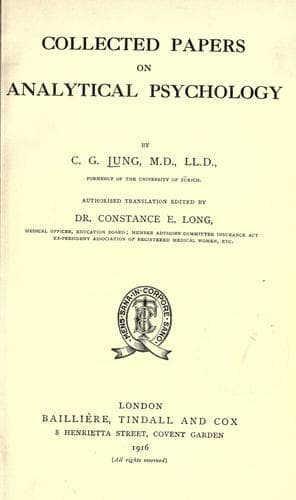
Collected Papers on Analytical PsychologyJung, C. G. (Carl Gustav)
Science
Collected Papers on Analytical Psychology
Jung, C. G. (Carl Gustav)
Psychoanalysis
As we have seen, the numerous personalities become grouped round two
types, the grandfather and Ulrich von Gerbenstein. The first produces
exclusively sanctimonious religiosity and gives edifying moral precepts.
The latter is, in one word, a "flapper," in whom there is nothing male
except the name. We must here add from the anamnesis that at fifteen the
patient was confirmed by a very bigoted clergyman, and at home she is
occasionally the recipient of sanctimonious moral talks. The grandfather
represents this side of her past, Gerbenstein the other half; hence the
curious contrast. Here we have personified the chief characteristics
of her past. On the one hand the sanctimonious person with a narrow
education, on the other the boisterousness of a lively girl of fifteen
who often overshoots the mark.[105] We find both sets of traits mixed
in the patient in sharp contrast. At times she is anxious, shy, and
extremely reserved; at others boisterous to a degree. She is herself
often most painfully aware of these contradictions. This circumstance
gives us the key to the source of the two unconscious personalities. The
patient is obviously seeking a middle path between the two extremes;
she endeavours to repress them and strains after some ideal condition.
These strainings bring her to the puberty dream of the ideal Ivenes,
beside whose figure the unacknowledged trends of her character recede
into the background. They are not lost, however, but as repressed
ideas, analogous to the Ivenes idea, begin an independent existence as
automatic personalities.
S. W.'s behaviour recalls vividly Freud's[106] investigations into
dreams which disclose the independent growth of repressed thoughts. We
can now comprehend why the hallucinatory persons are separated from
those who write and speak automatically. The former teach Ivenes the
secrets of the Other Side, they relate all those phantastic tales about
the extraordinariness of her personality, they create scenes where
Ivenes can appear dramatically with the attributes of power, wisdom and
virtue. These are nothing but dramatic dissociations of her dream-self.
The latter, the automatic persons, are the ones to be overcome, they
must have no part in Ivenes. With the spirit-companions of Ivenes they
have only the name in common. _A priori_, it is not to be expected that
in a case like ours, where these divisions are never clearly defined,
that two such characteristic individualities should disappear entirely
from a somnambulic ego-complex having so close a relation with the
waking consciousness. And in fact, we do meet them in part in those
ecstatic penitential scenes and in part in the romances crammed with
more or less banal, mischievous gossip.
COURSE.
Public-domain text, read in full here on John Shaqi.
Reviews
Reviews
No reviews yet
Be the first to share your thoughts on this work.
Elsewhere in the archive
Join the Discussion
Join the discussion
Sign in to leave a comment or review.
Sign InorCreate an account