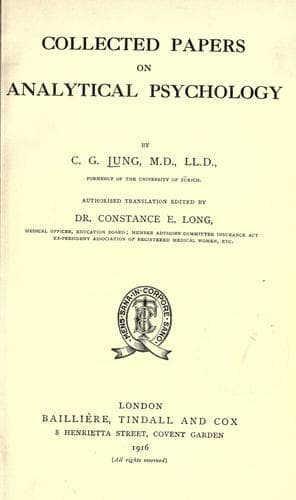
Collected Papers on Analytical PsychologyJung, C. G. (Carl Gustav)
Science
Collected Papers on Analytical Psychology
Jung, C. G. (Carl Gustav)
Psychoanalysis
It only remains to say a few words about the course of this strange
affection. The process reached its maximum in four to eight weeks. The
descriptions given of Ivenes and of the unconscious personalities belong
generally to this period. Thenceforth a gradual decline was noticeable;
the ecstasies grew meaningless and the influence of Gerbenstein became
more powerful. The phenomena gradually lost their distinctive features,
the characters which were at first well demarcated became by degrees
inextricably mixed. The psychological contribution grew smaller and
smaller until finally the whole story assumed a marked effect of
fabrication. Ivenes herself was much concerned about this decline; she
became painfully uncertain, spoke cautiously, feeling her way, and
allowed her character to appear undisguised. The somnambulic attacks
decreased in frequency and intensity. All degrees from somnambulism to
conscious lying were observable. Thus the curtain fell. The patient has
since gone abroad. We should not underestimate the importance of the
fact that her character has become pleasanter and more stable. Here we
may recall the cases cited in which the second state gradually replaced
the first state. Perhaps this is a similar phenomenon.
It is well known that somnambulic manifestations sometimes begin at
puberty.[107] The attacks of somnambulism in Dyce's case[108] began
immediately before puberty and lasted just till its termination. The
somnambulism of H. Smith is likewise closely connected with puberty.[109]
Schroeder von der Kalk's patient was 16 years old at the time of her
illness; Felida 14 1/2, etc. We know also that at this period the
future character is formed and fixed. In the case of Felida and of
Mary Reynolds we saw that the character in state II. replaced that
of state I. _It is not therefore unthinkable that these phenomena of
double consciousness are nothing but character-formations for the
future personality, or their attempts to burst forth._ In consequence
of special difficulties (unfavourable external conditions, psychopathic
disposition of the nervous system, etc.), _these new formations,
or attempts thereat, become bound up with peculiar disturbances
of consciousness_. Occasionally the somnambulism, in view of the
difficulties that oppose the future character, takes on a marked
teleological meaning, for it gives the individual, who might otherwise
be defeated, the means of victory. Here I am thinking first of all
of Jeanne d'Arc, whose extraordinary courage recalls the deeds of
Mary Reynolds' II. This is perhaps the place to point out the similar
function of the "hallucination téléologique" of which the public reads
occasionally, although it has not yet been submitted to a scientific
study.
THE UNCONSCIOUS ADDITIONAL CREATIVE WORK.
Public-domain text, read in full here on John Shaqi.
Reviews
Reviews
No reviews yet
Be the first to share your thoughts on this work.
Elsewhere in the archive
Join the Discussion
Join the discussion
Sign in to leave a comment or review.
Sign InorCreate an account