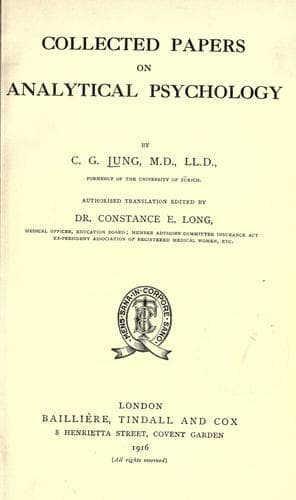
Collected Papers on Analytical PsychologyJung, C. G. (Carl Gustav)
Science
Collected Papers on Analytical Psychology
Jung, C. G. (Carl Gustav)
Psychoanalysis
We have now discussed all the essential manifestations offered by
our case which are of significance for its inner structure. Certain
accompanying manifestations may be briefly considered: _the unconscious
additional creative work_. Here we shall encounter a not altogether
unjustifiable scepticism on the part of the representative of science.
Dessoir's conception of a second ego met with much opposition, and was
rejected, as too impossible in many directions. As is known, occultism
has proclaimed a pre-eminent right to this field and has drawn premature
conclusions from doubtful observations. We are indeed very far from
being in a position to state anything conclusive, since we have at
present only most inadequate material. Therefore if we touch on the
field of the unconscious additional creative work, it is only that we
may do justice to all sides of our case. _By unconscious addition we
understand that automatic process whose result does not penetrate to
the conscious psychic activity of the individual._ To this region above
all belongs thought-reading through table movements. I do not know
whether there are people who can divine a whole long train of thought
by means of inductions from the intentional tremulous movements. It is,
however, certain that, assuming this to be possible, such persons must
be availing themselves of a routine achieved after endless practice. But
in our case long practice can be excluded without more ado, and there is
nothing left but to accept a primary susceptibility of the unconscious,
far exceeding that of the conscious.
This supposition is supported by numerous observations on somnambulists.
I will mention only Binet's[110] experiments, where little letters
or some such thing, or little complicated figures in relief were
laid on the anæsthetic skin of the back of the hand or the neck, and
the unconscious perceptions were then recorded by means of signs. On
the basis of these experiments he came to the following conclusion:
"D'après les calculs que j'ai pu faire, la sensibilité inconsciente
d'une hystérique est à certains moments _cinquante fois_ plus fine que
celle d'une personne normale." A second additional creation coming under
consideration in our case and in numerous other somnambulists, is that
condition which French investigators call "cryptomnesia."[111] By this
term is meant the becoming conscious of a memory-picture which cannot
be regarded as in itself primary, but at most is secondary, by means
of subsequent recalling or abstract reasoning. It is characteristic of
cryptomnesia that the picture which emerges does not bear the obvious
mark of the memory-picture, is not, that is to say, bound up with the
idiosyncratic super-conscious ego-complex.
Three ways may be distinguished in which the cryptomnesic picture is
brought to consciousness.
Public-domain text, read in full here on John Shaqi.
Reviews
Reviews
No reviews yet
Be the first to share your thoughts on this work.
Elsewhere in the archive
Join the Discussion
Join the discussion
Sign in to leave a comment or review.
Sign InorCreate an account