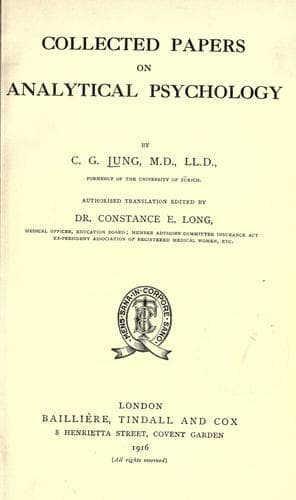
Collected Papers on Analytical PsychologyJung, C. G. (Carl Gustav)
Science
Collected Papers on Analytical Psychology
Jung, C. G. (Carl Gustav)
Psychoanalysis
3. _The image arrives at consciousness by motor automatism._ H. Smith
had lost her valuable brooch, which she was anxiously looking for
everywhere. Ten days later her guide Leopold informed her by means
of the table where the brooch was. Thus informed, she found it at
night-time in the open field, covered by sand.[120] Strictly speaking,
in cryptomnesia there is not any additional creation in the true sense
of the word, since the conscious memory experiences no increase of its
function, but only an enrichment of its content. By the automatism
certain regions are merely made accessible to consciousness in an
indirect way, which were formerly sealed against it. But the unconscious
does not thereby accomplish any creation which exceeds the capacity of
consciousness qualitatively or quantitatively. Cryptomnesia is only an
apparent additional creation, in contrast to hypermnesia, which actually
represents an increase of function.[121]
We have spoken above of a receptivity of the unconscious greater
than that of the consciousness, chiefly in regard to the simple
attempts at thought-reading of numbers. As mentioned, not only our
somnambulist but a relatively large number of normal persons are able
to guess from the tremors lengthy thought-sequences, if they are not
too complicated. These experiments are, so to speak, the prototype
of those rarer and incomparably more astonishing cases of intuitive
knowledge displayed at times by somnambulists.[122] Zschokke[123] in
his "Introspection" has shown us that these phenomena do not belong
only to the domain of somnambulism, but occur among non-somnambulic
persons. The formation of such knowledge seems to be arrived at in
various ways: first and foremost there is the fineness, already noted,
of unconscious perceptions; then must be emphasised the importance of
the enormous suggestibility of somnambulists. _The somnambulist not
only incorporates every suggestive idea to some extent, but actually
lives in the suggestion, in the person of his doctor or observer,
with that abandonment characteristic of the suggestible hysteric._
The relation of Frau Hauffe to Kerner is a striking example of this.
That in such cases there is a high degree of _association-concordance_
can cause no astonishment; a condition which Richet might have taken
more account of in his experiments in thought-transference. Finally
there are cases of somnambulic additional creative work which are not
to be explained solely by hyperæsthesia of the unconscious activity
of the senses and association-concordance, but presuppose a highly
developed intellectual activity of the unconscious. The deciphering
of the purposive tremors demand an extreme sensitiveness and delicacy
of feeling, both psychological and physiological, to combine the
individual perceptions into a complete unity of thought, if it is at
all permissible to make an analogy between the processes of cognition
in the realm of the unconscious and the conscious. The possibility
Public-domain text, read in full here on John Shaqi.
Reviews
Reviews
No reviews yet
Be the first to share your thoughts on this work.
Elsewhere in the archive
Join the Discussion
Join the discussion
Sign in to leave a comment or review.
Sign InorCreate an account