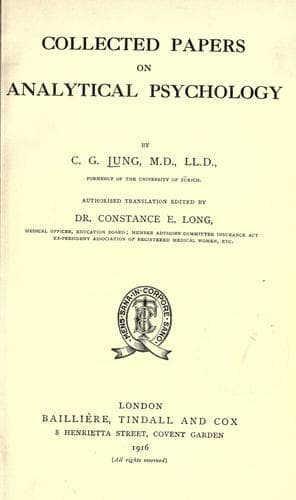
Collected Papers on Analytical PsychologyJung, C. G. (Carl Gustav)
Science
Collected Papers on Analytical Psychology
Jung, C. G. (Carl Gustav)
Psychoanalysis
must always be considered that _in the unconscious, feeling and concept
are not clearly separated_, perhaps even are one. The intellectual
elevation which certain somnambulists display in ecstasy, though a rare
thing, is none the less one that has sometimes been observed.[124] I
would designate the scheme composed by our patient as just one of those
pieces of creative work that exceed the normal intelligence. We have
already seen whence one portion of this scheme probably came. A second
source is no doubt the life-crisis of Frau Hauffe, portrayed in Kerner's
book. The external form seems to be determined by these adventitious
facts. As already observed in the presentation of the case, the idea of
dualism arises from the conversations picked up piecemeal by the patient
during those dreamy states occurring after her ecstasies. This exhausts
my knowledge of the sources of S. W.'s creations. Whence arose the
root-idea the patient is unable to say. I naturally examined occultistic
literature pertinent to the subject, and discovered a store of parallels
with her gnostic system from different centuries scattered through all
kinds of work mostly quite inaccessible to the patient. Moreover, at
her youthful age, and with her surroundings, the possibility of any
such study is quite excluded. A brief survey of the system in the light
of her own explanations shows how much intelligence was used in its
construction. How highly the intellectual work is to be estimated is a
matter of opinion. In any case, considering her youth, her mentality
must be regarded as quite extraordinary.
FOOTNOTES:
[Footnote 1: Thesis published in 1902. Translator, M. D. Eder, M.D.]
[Footnote 2: _Arch. f. Psych._, XXXIII. p. 928.]
[Footnote 3: Richer, "Études cliniques sur l'hystéro-épilepsie," p. 483.]
[Footnote 4: _Idem_, _l.c._, p. 487; cp. also Erler, _Allg. Zeitschrift
f. Psychiatrie_, XXXV. p. 28; also Culerre, _Allg. Zeit. f. Psych._,
XLVI., Litteraturbericht 356.]
[Footnote 5: Charcot and Guinon, "Progrès méd.," 1891.]
[Footnote 6: "Somnambulism must be conceived as systematised partial
waking, in which a limited, connected presentation-complex takes place.
Contrary presentations do not occur, at the same time the mental
activity is carried on with increased energy within the limited sphere
of the waking" (Lowenfeld, "Hypnotism," 1901, p. 289).]
[Footnote 7: Azam, "Hypnotisme--Double conscience," etc., Paris, 1887.
For similar cases, cf. Forbes Winslow, "On Obscure Diseases," p. 335.]
[Footnote 8: _Trib. méd._, March, 1890.]
[Footnote 9: _Annal. méd. psychol._, Jan., Feb., 1892.]
[Footnote 10: "Principles of Psychology," p. 391.]
[Footnote 11: Mesnet, "De l'automatisme de la mémoire et du souvenir
dans le somnambulisme pathologique." Union médicale, Juillet, 1874. Cf.
Binet, "Les Altérations de la personnalité," p. 37. Cf. also Mesnet,
"Somnambulisme spontané dans ses rapports avec l'hystérie," _Arch. de
Neurol._, Nr. 69, 1892.]
Public-domain text, read in full here on John Shaqi.
Reviews
Reviews
No reviews yet
Be the first to share your thoughts on this work.
Elsewhere in the archive
Join the Discussion
Join the discussion
Sign in to leave a comment or review.
Sign InorCreate an account