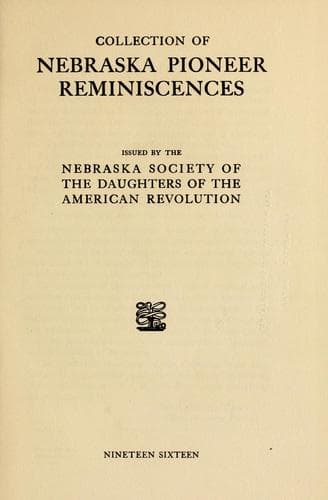
Collection of Nebraska Pioneer ReminiscencesDaughters of the American Revolution. Nebraska
History
Collection of Nebraska Pioneer Reminiscences
Daughters of the American Revolution. Nebraska
Frontier and pioneer life -- Nebraska; Nebraska -- History
One hundred and three years ago Hannah Norton was born "away down east"
in the state of Maine. Hannah married Jason Plummer, and in the year
1844, seized by the wanderlust, they decided to move west. One morning
their little daughter Eleanor, four years old, stood outside the cabin
door with her rag doll pressed tightly to her breast, and watched her
parents load their household goods into the heavy, covered wagon, yoke
up the oxen, and make preparations for a long journey.
As little Eleanor clambered up the wheel and into the wagon, she felt
none of the responsibilities of the long pioneer life that lay before
her, nor did she know or care about her glorious ancestry.
Only a few decades previous her ancestor, Major Peter Norton, who had
fought gallantly in the war of the Revolution, had gone to his
reward. His recompense on earth had been the consciousness of
patriotic duty well performed in the cause of liberty and
independence. A hero he was, but the Maine woods were full of
Revolutionary heroes. He was not yet famous. It was reserved for
Peter Norton's great-great-great-granddaughters to perpetuate the
story of his heroic deeds. One, Mrs. Auta Helvey Pursell, the
daughter of our little Eleanor, is now a member of Quivera chapter,
D. A. R., of Fairbury, Nebraska, and another, Lillian Norton, is
better known to the world she has charmed with her song, as Madame
Nordica.
But little Eleanor was wholly unmindful of past or future on that
morning long ago. She laughed and chattered as the wagon rolled slowly
on its westward way.
A long, slow, and painful journey through forests and over mountains,
then down the Ohio river to Cincinnati was at last finished, and the
family made that city their home. After several years the oxen were
again yoked up and the family traveled to the West, out to the prairies
of Iowa, where they remained until 1863. Then, hearing of a still
fairer country where free homes could be taken in fertile valleys that
needed no clearing, where wild game was abundant and chills and fever
unknown, Jason, Hannah, and Eleanor again traveled westward. After a
toilsome journey they settled in Swan creek valley, Nebraska territory,
near the present northern line of Jefferson county.
Theirs were pioneer surroundings. The only residents were ranchers
scattered along the creeks at the crossings of the Oregon trail. A few
immigrants came that year and settled in the valleys of the Sandys, Swan
creek, Cub creek, Rose creek, and the Little Blue. No human habitation
stood upon the upland prairies. The population was four-fifths male, and
the young men traveled up and down the creeks for miles seeking partners
for their dances, which were often given. But it was always necessary
for a number of men to take the part of ladies. In such cases they wore
a handkerchief around one arm to distinguish them.
Public-domain text, read in full here on John Shaqi.
Reviews
Reviews
No reviews yet
Be the first to share your thoughts on this work.
Elsewhere in the archive
Join the Discussion
Join the discussion
Sign in to leave a comment or review.
Sign InorCreate an account