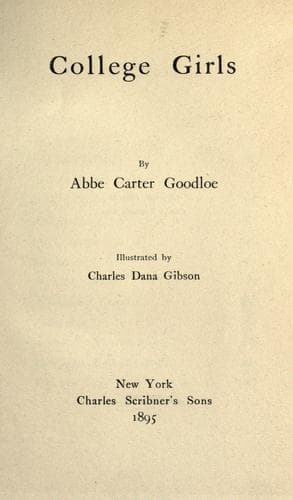
College stories; Women college students -- Fiction
It was therefore with both delight and surprise that, just before
starting for Europe, Miss Hungerford received a rather gloomy letter
from her young cousin, who said that with such a brilliant example
before her, and deeply impressed by the weighty arguments in her
cousin’s letter, she had told the Harvard man that she was much too
young and ignorant to marry, and fully convinced that society was a
hollow sham, she had determined to devote the next four years to those
pursuits which had raised her cousin so far above the ordinary girl. She
was even greatly interested, she said, in her preparations for the
entrance examinations which she would take at Philadelphia, and the
chances of her being admitted. Miss Hungerford was quite touched by the
little tribute to herself contained in the letter, and wrote a most
cordial answer, and rather upbraided herself for having thought so
lightly of her cousin. But her mother seemed to be distressingly
sceptical about Margaret’s heroic determination, and said she shouldn’t
wonder if some misunderstanding with the Harvard man were not at the
bottom of it. But Miss Hungerford was confident that such a lofty
purpose could have been born only of some noble sentiment, and refused
to have her faith in her young cousin shaken by such a supposition.
When Miss Wright got off the train at the pretty little station, she
found herself in the midst of a sufficiently large crowd of young women,
all of whom seemed to be aggravatingly well acquainted with each other,
and who set about in a most business-like way to get where they wanted
to go, some taking “barges” and omnibuses, others striking out easily
over the roads in the direction of the college. Being totally unfamiliar
with the place and somewhat bewildered by the number of girls, Miss
Wright thought she would simply take a carriage and get up to the
college as quickly as possible.
She never told anyone but her best friend what were her sensations on
reaching the big building and being “numbered” for an interview with one
of the assistant professors, instead of seeing the president herself, as
she had expected to do; or how hurt she felt at being totally ignored by
the vast majority of busy, rather severe-looking young women, or how
grateful she felt to a patronizing Sophomore who talked to her kindly,
if condescendingly, for a few moments and who took her through unending
corridors to her rooms. Later in the day she found two or three girls
who wore tailor-made travelling gowns and seemed ill at ease, and they
all huddled together in a corner of one of the big corridors and talked
rather helplessly to each other. They would have liked to know what the
peals on the big Japanese bell meant, and if they were expected to do
anything about it, but they were afraid to ask anyone, because they were
not sure which were the professors and which the students.
Public-domain text, read in full here on John Shaqi.
Reviews
Reviews
No reviews yet
Be the first to share your thoughts on this work.
Join the Discussion
Join the discussion
Sign in to leave a comment or review.
Sign InorCreate an account