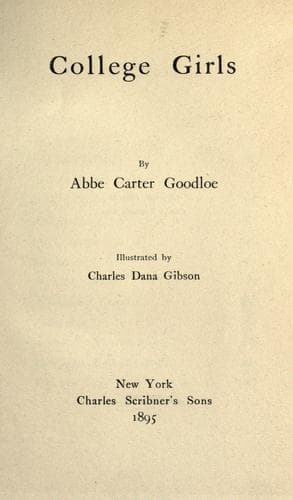
College stories; Women college students -- Fiction
“I know him better than that. I know things of him that will not be told
in newspaper paragraphs and book reviews.” She paused and her face grew
whiter. “You read his stories, and because they are the best of their
kind, the most correct, the most interesting, because his men are the
men you like to know, men who are always as they should be to men,
because there is an atmosphere of refinement and elegance and pleasing
conventionality about them--you think they must be the reflex of
himself. O yes! I know--the very last story--you have all read it--who
could be more magnificent and correct than _Roscommon_? And you think
_him_ like his hero! There is not one of you but would feel flattered at
his attentions, you might easily fall in love with him--I dare say you
would scarcely refuse him--and yet”--she broke off suddenly.
“There was a girl,” she began after a moment’s hesitation, in a tone
from which all the excitement had died, “a friend of mine, and she loved
him. Perhaps you do not know that before he became famous he lived in a
small Western town--she lived there too. They grew up together, and she
was as proud of him--well, you know probably just how proud a girl can
be of a boy who has played with her and scolded her and tyrannized over
her and protected her and afterward loved her. For he _did_ love her. He
told her so a thousand times and he showed it
[Illustration: SHE STOPPED AND HER FACE GREW WHITER]
to her in a thousand ways. And she loved him! I cannot tell you what he
was to her.” They were all looking curiously at her white face and she
tried to speak still more calmly.
“Well, after a time his ambition--for he was very ambitious and very
talented--made him restless. He wanted to go East--he thought he would
succeed. She let him go freely, willingly. His success was hers, he
said. Everything he was to do was for her, and she let him go, and she
told him then that he could be free. But he was very angry. He said that
he would never have thought of going but to be better worthy of her. He
succeeded--you know--the world knows how well he has succeeded, and the
world likes success, and what wonder that he forgot her. She was
handsome--at least her friends told her so--but she was not like the
girls he knows now. She was not rich, and she had never been used to the
life of luxury and worldliness to which he had so quickly accustomed
himself. But,” she went on, protestingly, as if in reply to some
unspoken argument or some doubt that had assailed her, “she could have
been all he wished her. She was quick and good to look at, and
well-bred. She could have easily learned the world’s ways--the ways that
have become so vital to him.”
She stopped, and then went on with an air of careful impartiality, as if
trying to be just, to look at both sides of the question, and her
beautiful face grew whiter with the effort.
Public-domain text, read in full here on John Shaqi.
Reviews
Reviews
No reviews yet
Be the first to share your thoughts on this work.
Join the Discussion
Join the discussion
Sign in to leave a comment or review.
Sign InorCreate an account