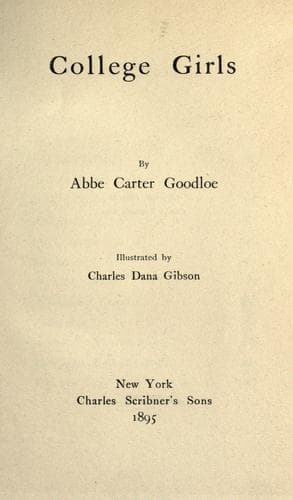
College stories; Women college students -- Fiction
She never knew just how it happened. Certainly she had never encouraged
him, though she had sometimes suspected her mother of doing so, and
assuredly Paul Stanhope in no way corresponded to her ideal hero. A few
years ago she would not have admitted that she had a masculine ideal,
but now, as she put another cushion under her shoulder, she was forced
to admit to herself that she might have one. Stanhope was big and strong
and handsome. So far he answered to her ideal. But was he intellectual?
He drove a four-in-hand splendidly, but that was hardly an intellectual
employment. Was he literary? She remembered that in speaking once of
Matthew Arnold’s “Monody on the Death of Arthur Hugh Clough,” she had
noticed a distinctly blank expression on his face, and that he had tried
to turn the conversation. But Miss Hungerford had been too quick for him
and had herself changed the subject. That was one of her best points, as
she acknowledged to herself. She could adapt herself to the people she
happened to be talking to. But could she do so for a lifetime? Miss
Hungerford shuddered and pressed her hands more tightly over her eyes,
as if to keep out the vision of a husband who did not appreciate
allusions to the “Cumnor cowslips.”
Then in some way the phrase “Art is long” got into her head. She knew
it, and was not afraid. She had said it to herself a thousand times to
keep up her courage. She knew she was only beginning. Still she did
think the critics might have noticed more positively that she was
beginning. But nothing should turn her from her purpose. She was sure
the American drama needed fresh material, fresh workers. She had studied
French methods, and had determined to devote the rest of her life to
adapting them to the American stage. Her youth would be well spent in
regenerating our drama and elevating our literature, though she should
not become famous until she was an old woman. Even with such high
resolves for our country’s good, Miss Hungerford could not entirely
relinquish all hope of becoming renowned.
“An old woman!” She jumped up and, drawing the silk curtains slightly,
gazed at herself in the mirror. She leaned forward and breathed lightly
on the glass, so that the reflection might be more soft and exquisite.
“It must be hard to lose one’s good looks!” she said, half aloud.
Generally, when Miss Hungerford was tempted to be vain, she laid it all
to an exalted, abstract love of the beautiful. Now she put her hands
through her hair at each side and drew it down loosely, so that her face
was half in shadow and altogether charming. And then she put it back
suddenly, for she remembered that it had fallen down so once when she
and Stanhope were riding together, and he had looked at her in a very
openly admiring way. When he had next called she had worn it so, and his
look and exclamation of delight when she had entered the room had warned
her what risks she was running.
Public-domain text, read in full here on John Shaqi.
Reviews
Reviews
No reviews yet
Be the first to share your thoughts on this work.
Elsewhere in the archive
Join the Discussion
Join the discussion
Sign in to leave a comment or review.
Sign InorCreate an account