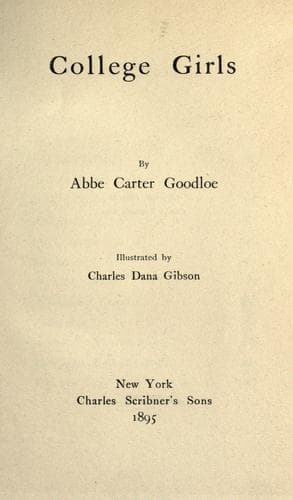
College stories; Women college students -- Fiction
She turned impatiently from the mirror and picked up a book that her
“most intimate friend” had sent her several days before. She had not
read it, because she had found that it commenced with a very modern love
scene, and she never read love scenes. Miss Hungerford, who had a taste
for epigram, once told her friend that “the science of reading is to
know how to skip,” and she usually skipped the _lui et elle_ dialogues,
but if they occurred in a classic, and she felt that she had no right to
omit anything (she was a very conscientious sort of person) she summoned
all her fortitude to aid her in getting through. Now she opened the book
and read a few pages. After all, it did not seem absolutely repulsive.
She decided that she had not given the book a fair trial, and she
noticed with some surprise that, curiously enough from the description
of him, the hero of the story must resemble Paul Stanhope. But when she
found that she was thinking of Stanhope she put the book down.
“I am certainly getting frivolous,” she thought severely.
“I will go up to my study. I can think better there.” As she passed her
little French clock, she noticed with a slight shudder that it was
twenty minutes after four. She stopped suddenly and rang a bell. “I will
make it easy for both of us,” she decided; “I will order tea served as
usual, and I will just tell him very calmly how impossible it is for me
to take upon myself any other career than that of a student and writer.
No one can possibly be sentimental over a tea-urn and champagne
biscuits,” she thought with relief. When the man appeared she gave him
instructions to bring in the tea-things at five precisely. “That will
make our interview short and yet give me time to settle it all at once
and forever,” she thought. “Afterward we can discuss every-day affairs,
and I am sure he will recognize how wisely I have acted, and we can be
very good friends,” and she passed slowly up the stairs to her
particular den.
She felt stronger now, more certain of herself. The first sheets of her
“curtain-raiser” were lying on her desk, and the sight of them
encouraged her. For a moment a bewildering vision of a crowded theatre,
a storm of applause, and herself, seated behind the curtains of a box,
seeing, hearing her own piece, took possession of her. She even heard
cries for the author, but of course her duty to herself and her family
would prevent her appearing publicly as the writer of the play. She
could see no objection, however, to being pointed out as “Miss
Hungerford, you know, the brilliant young authoress.” Yes, life was a
failure, art was everything! Nothing should ever come between her and
her work.
Public-domain text, read in full here on John Shaqi.
Reviews
Reviews
No reviews yet
Be the first to share your thoughts on this work.
Elsewhere in the archive
Join the Discussion
Join the discussion
Sign in to leave a comment or review.
Sign InorCreate an account