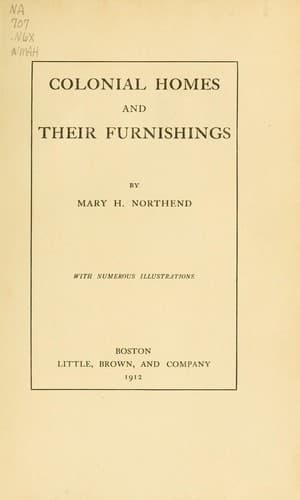
Colonial Homes and Their FurnishingsNorthend, Mary Harrod
History
Colonial Homes and Their Furnishings
Northend, Mary Harrod
Architecture, Colonial; Furniture -- United States
We find in the earliest records of the new settlers allusions to
flowers, and Reverend Francis Higginson speaks of the wild flowers which
he saw blossoming near the shore. He considered them of enough
importance to record in his diary on June 24, 1629, writing "that wild
flowers of yellow coloring resembling Gilliflowers were seen near the
shore as they sighted land, and that as they came closer they saw many
of these flowers scattered here and there, some of the plots being from
nine to ten feet in size."
Four of the men who went ashore on the twenty-seventh of that month
found on the headlands of Cape Cod single wild roses. Later on he tells
again of the number of plants found growing, giving their names. These
facts have enabled people in later years to locate the same flowers
growing near the same places as when they were first discovered.
Governor Bradford also considered the flowers of importance, and in his
historical account of the Colonies of New England, he tells us that
"here grow many fine flowers, among them the fair lily and the fragrant
rose."
On Governors Island in Boston Harbor were rich vineyards and orchards,
as well as many varieties of flowers. Governor Winthrop, inserting a
clause in the grant, said that vineyards and orchards should be planted
here; that this was complied with is shown from the fact that the rent
in 1634 was paid with a hogshead of wine.
Following the growth of colonist gardens, we find that John Josslyn
arrived in Boston four years later, in 1638, and that soon after his
arrival he visited his brother's plantation in Black Point, Maine. He
made a careful list of plants that he found here, each one of which he
carefully described and sent in part to England, and it is interesting
to note that in those days, the colonists in the spring gathered
hepaticas, bloodroot, and numerous other wild flowers.
His description of the pitcher plant is graphic: "Hollow leaved lavender
is a plant that grows in the marshes, overgrown with moss, with one
straight stalk about the bigness of an oat straw. It is better than a
cubic high, and upon the top is found one single fantastic flower. The
leaves grow close to the root in shape like a tankard, hollow, tight,
and always full of water." The whole plant, so he says, comes into
perfection about the middle of August, and has leaves and stalks as red
as blood, while the flower is yellow.
Mr. Josslyn also speaks of the fact that shrubs and flowers brought from
England and Holland by the Puritans as early as 1626 were the nucleus
of old-fashioned gardens, and that woadwaxen, now a pest covering acres
of ground and showing during the time of blossoming a brilliant yellow,
was kept in pots by Governor Endicott, while the oxeye daisy and
whiteweed were grown on Governor Endicott's Danvers farm.
Public-domain text, read in full here on John Shaqi.
Reviews
Reviews
No reviews yet
Be the first to share your thoughts on this work.
Join the Discussion
Join the discussion
Sign in to leave a comment or review.
Sign InorCreate an account