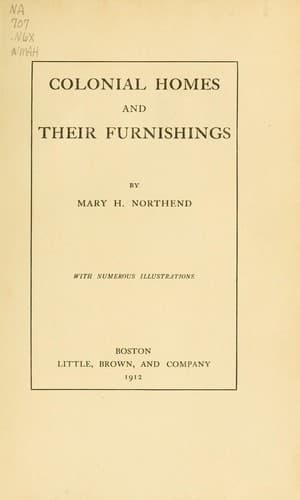
Colonial Homes and Their FurnishingsNorthend, Mary Harrod
History
Colonial Homes and Their Furnishings
Northend, Mary Harrod
Architecture, Colonial; Furniture -- United States
Intimately associated with the sideboard is the table which probably
shows more variety in design than any of the other old-time furnishings.
From the table board or top used in 1624, square, oval, or round in
contour, evolved the butterfly table popular about 1700, many examples
of which are found throughout Connecticut. These followed in form the
outline of a butterfly, and were supported by pieces of wood shaped much
like the rudder of a ship. Other types popular here were the Dutch
table, the hundred-legged table, the dish-top table, and the tea table.
The first table used in this country was the table top, which was
literally a board made separate from its supports, which was taken off
and placed at one side of the room after meals. This showed different
forms, and was known by different names, one called the chair table, and
so constructed that when not in use it served as a seat, being probably
the most unique. It was invariably fashioned with drawers.
Included in the later designs were writing tables fashioned by Sheraton,
showing elegant carving at the back, the most decorative of these, known
as the "Kidney" based table, being used either for writing or as a
lady's worktable. Another model of Sheraton's was a worktable known as
the Pouch Table, arranged with a bag of drawn silk. These were often
fitted with drawers and a sliding desk, which drew forward from beneath
the table top.
The dining table of this period showed the pillar and claw style with
central leg fixed to a block, on which the table hinged. This principle
received the support of the English people for many years, and Sheraton
tables of this make had four claws to each pillar, and castors of brass.
So much did Sheraton designs resemble those of French artisans that only
close inspection will decide as to which cabinet-maker a certain piece
belongs.
Following this type came the telescopic table, showing extensions fitted
through slides moving in grooved channels.
Other later tables were card tables, which closed and could be stood
against the wall when not in use, the pie-crust table of the Dutch style
of make, and the table with scalloped moldings carved from solid pieces
of wood, with legs terminating in claw-and-ball feet. Tables of Empire
design often have brass feet and lyre supports, while others show the
rope carving and acanthus leaf.
Popular types of the later days of the eighteenth century were Pembroke
tables, small and of ornamental design, with inlaid tops and brackets to
supply the two side flaps, as well as Pier tables, circular or
serpentine in shape.
CHAPTER X
FOUR-POSTERS
Public-domain text, read in full here on John Shaqi.
Reviews
Reviews
No reviews yet
Be the first to share your thoughts on this work.
Elsewhere in the archive
Join the Discussion
Join the discussion
Sign in to leave a comment or review.
Sign InorCreate an account