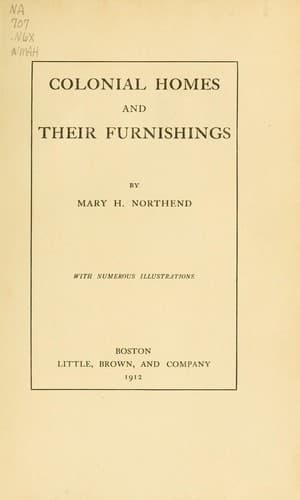
Colonial Homes and Their FurnishingsNorthend, Mary Harrod
History
Colonial Homes and Their Furnishings
Northend, Mary Harrod
Architecture, Colonial; Furniture -- United States
At no time since the days of the Renaissance has interest been so keen
in interior decoration as it is at the present day, not only as regards
the main living rooms of the home, but the sleeping apartments as well.
This has resulted in a revival of old-time features, and the chamber
fittings of the present in many cases are similar in type to those of
early times, when purely classical designs were in vogue,--models that
have never been surpassed in beauty by later designers, though many a
fine piece of furniture has been made since then by expert
cabinet-makers.
Early specimens showed a delicacy of touch and a mastery of thought that
gave to them a lasting place in the world of architecture, and while the
coming historian may dilate upon twentieth-century models, he cannot
make any comparison that will in any way be derogatory to these
wonderfully fine old pieces. In early days, labor was a very different
problem from what it is to-day, years being often spent in the making of
a single specimen of furniture, and, indeed, in some countries, a
workman has been known to have spent his whole life in the fashioning of
a single piece.
Taking these points into consideration, one cannot wonder that early
century pieces are still as perfect as they were the day that they left
the makers' hands, and it is with regret that he views the hurry and
rush of modern times resulting in the practical abolition of hand
carving, and the introduction of machinery that has helped in the
deterioration of the art. Reproductions, as they are made to-day, while
in many cases very beautiful, cannot equal in finish the originals
fashioned at a time when art was the first consideration.
Fortunately, many genuine antiques are still in existence, and present
interest for the most part centers in their types and periods of
manufacture. With so many periods and so many makers, it is not
surprising that mistakes in these respects are sometimes made,
especially as regards the bedstead. For the best of these, one need not
search farther back than the seventeenth century, for the most valuable
specimens were made in the seventeenth and eighteenth centuries, many
of these to-day bringing from two to three hundred dollars apiece.
Of course, these fine beds were not the first beds used here, though no
doubt the earlier types, as well as these later specimens, were imported
from England, along with the other household furnishings. If any
bedsteads were made here, they were undoubtedly simple and
unpretentious, along the lines of the settle and board tables.
Public-domain text, read in full here on John Shaqi.
Reviews
Reviews
No reviews yet
Be the first to share your thoughts on this work.
Elsewhere in the archive
Join the Discussion
Join the discussion
Sign in to leave a comment or review.
Sign InorCreate an account