"confederation" between independent states. Such connections are
properly called "alliances" or "confederations." The only true
connections are those in which there is a legislative medium, whether
a person, a body corporate or a state, whose legislative powers are
limited, by agreement of the connected states, to the common
purposes, and those in which there is a justiciary medium, whether a
person, a body corporate, or a state, which recognizes its powers as
limited to the common purposes by the law of nature and of nations,
and which ascertains and applies this law, incidentally adjudicating,
according to this law, the limits of its own jurisdiction. Just
connections tend to become unions, it being found in practice
necessary, for the preservation of the connection in due order, that
the power of limited legislation for the common purposes and the power
of adjudicating and applying the law for the common purposes should
extend not only to the states, but to all individuals throughout the
states.
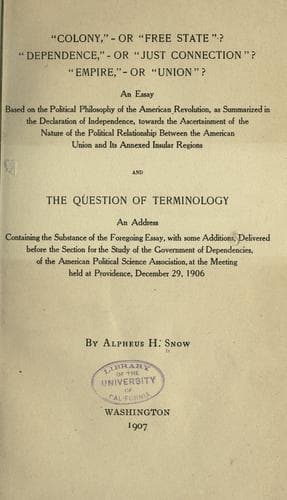
Thus "dependence," as a fictitious and vicious form of connection, is,
it would appear, forever opposed to "connection" of a just and proper
kind. If it were attempted to sum up the issue of the American
Revolution in an epigram, would not that epigram be: "'Colony,' or
'Free State?' 'Dependence,' or 'Just Connection?' 'Empire,' or
'Union?'"
According to the opinion of the Revolutionary statesmen, as it would
seem, a universal right of free statehood does not imply a universal
right of self-government. Statehood and self-government are two
different and distinct conceptions. The Americans claimed the right of
free statehood as a part of the universal rights of man, but they
claimed the right of self-government because they were Englishmen
trained by generations of experience in the art of self-government and
so capable of exercising the art. A state is not less or more a free
state because it has self-government. It is a free state when its just
public sentiment is to any extent ascertained and executed by its
government,--however that government may be instituted,--free from the
control of any external power. It does not prevent a region from being
a free state that its government is wholly or partly appointed by an
external power, if that government is free from external control in
ascertaining and executing the just local sentiment to any extent. Nor
does it interfere with the right of free statehood when an external
power stands by merely to see that the local government ascertains
and executes the just local sentiment to a proper extent. The external
power in that case is upholding the free statehood of the region. It
stands as surety for the continuance of free statehood.
Public-domain text, read in full here on John Shaqi.
Reviews
Reviews
No reviews yet
Be the first to share your thoughts on this work.
Join the Discussion
Join the discussion
Sign in to leave a comment or review.
Sign InorCreate an account