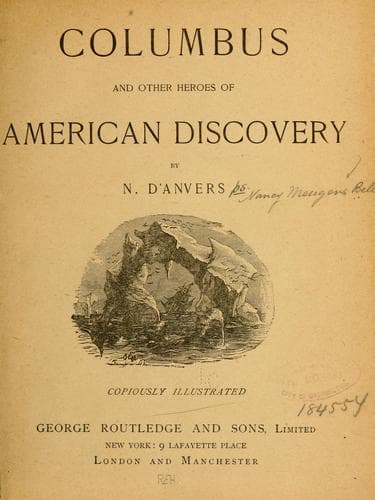
Columbus and Other Heroes of American DiscoveryD'Anvers, N.
History
Columbus and Other Heroes of American Discovery
D'Anvers, N.
America -- Discovery and exploration; North America -- Discovery and exploration
It was evidently useless to remain longer on the coast, and La Salle
now came to the desperate resolution of making his way back to Canada
on foot. With sixteen companions, he started for the work, supporting
himself and his party by hunting the wild animals of the prairie; and
but for treachery, among his followers, he would probably have lived
to tell the tale of a journey of which every stage was full of the
most thrilling adventure. As it was, however, the wanderers had not
proceeded very far before La Salle’s nephew, Moranget, was murdered by
two men named Dubaut and L’Archeveque, who had long cherished bitter
feelings against the family, in whose enterprise they had embarked all
their capital. La Salle, coming up soon after Moranget’s death, and
missing him from among the party, put the simple question, “Where is
my nephew?” The only reply was a loud report from the gun of Dubaut,
and La Salle fell dead at his feet. His body and Moranget’s were
stripped, and left on the prairie to be devoured by eagles and wild
beasts, while the murderers calmly pursued their way. It is with
little regret that we add that they were shortly afterward themselves
slain by Indians, and that of the original party, seven only――fourteen
long years after the starting of the original expedition――reached
Arkansea, on the Mississippi, where they were kindly received by the
Indians, who gave them a letter from Tonti to La Salle, which had
been left with them when the former, having given up all hope of the
arrival of his friend, had returned to the lakes of Canada.
Illustration: ASSASSINATION OF LA SALLE.
While La Salle was vainly struggling to accomplish the end for which
he had sailed to Louisiana, the French were not idle in the North.
In the rich peltries of the far West the fur-traders found a source
of wealth rivaling even the mines of the South, and a class of
men――unique alike in their manners and their experiences――sprang
up, as it were, in the heart of the wilderness, to whom the name of
_coureurs des bois_ was given. These rangers of the woods seem to
have left behind them the European prejudice against the natives,
and in their wild expeditions in remote tracts, and among distant
tribes, they adopted the Indian mode of dress, contracted marriages
with “squaws,” and brought up their half-caste children to lead a
life differing but slightly, if at all, from that of their mothers’
relations. The usual result followed: the natives copied the vices of
their visitors without their virtues, and but for the missionaries,
who settled wherever there seemed to be a hope of winning even a few
souls to God, natives and settlers would have been involved in one
common ruin, alike of body and soul.
Public-domain text, read in full here on John Shaqi.
Reviews
Reviews
No reviews yet
Be the first to share your thoughts on this work.
Elsewhere in the archive
Join the Discussion
Join the discussion
Sign in to leave a comment or review.
Sign InorCreate an account