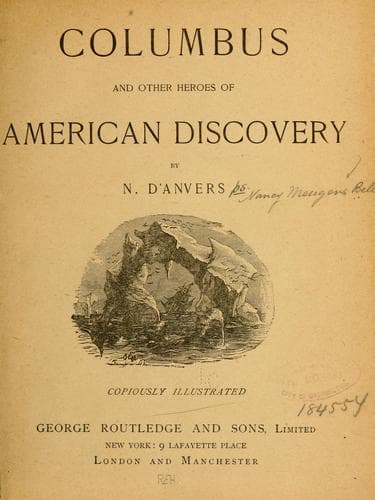
Columbus and Other Heroes of American DiscoveryD'Anvers, N.
History
Columbus and Other Heroes of American Discovery
D'Anvers, N.
America -- Discovery and exploration; North America -- Discovery and exploration
Little by little the traders and missionaries penetrated as far north
as Hudson’s Bay, and as far west as the Saskatchewan, the shores of
which were dotted with trading houses and chapels long before its very
name was heard in Europe. Unfortunately, however, neither the seekers
after souls nor the hunters of peltries were men to talk much of their
exploits, and though fiction has drawn largely from life in the far
West in these early days for thrilling situations, little is known of
the facts of the first intercourse of the white man with the various
races of the great western hyperborean group of nations. Not until the
powerful rival of the French in the West, the Hudson’s Bay Company――of
the growth of which particulars are given elsewhere――had sent forth
its heroes on expeditions which were something more than trading
excursions, did the first volumes appear of that extensive and
fascinating literature of western travel from which the latter part
of our narrative will be culled.
To atone for the reticence of the fur-trader and missionary in the
far North-west, traveler after traveler succeeded Marquette and
La Salle in exploring the great lakes of Canada and the shores of
the Mississippi. Of these, one of the chief was Baron La Hontan,
who, starting from Lake Michigan, went down the Wisconsin to the
Mississippi, and is supposed to have very nearly approached the
settlements of the Spanish New Mexico. In any case, he heard from some
Indians, whom he called the Guaczitares――a name we altogether fail to
recognize as that of any known tribe――of the existence of white men in
the South; and, what was perhaps of more importance, he learned from
some visitors to the Guaczitares that they came from a country beyond
which lay high ♦mountains, only to be crossed with great difficulty,
but that those who had crossed them had reached a big salt lake
300 leagues round, and with a wide opening to the south. From the
mountains one great river flowed into the lake, and another eastward
to the Miche Sepe. The big salt lake was probably that part of the sea
now known as Queen Charlotte’s Sound, the river flowing into it the
Columbia, and the mountain range the Rocky Mountains.
♦ ‘moutains’ replaced with ‘mountains’
Public-domain text, read in full here on John Shaqi.
Reviews
Reviews
No reviews yet
Be the first to share your thoughts on this work.
Elsewhere in the archive
Join the Discussion
Join the discussion
Sign in to leave a comment or review.
Sign InorCreate an account