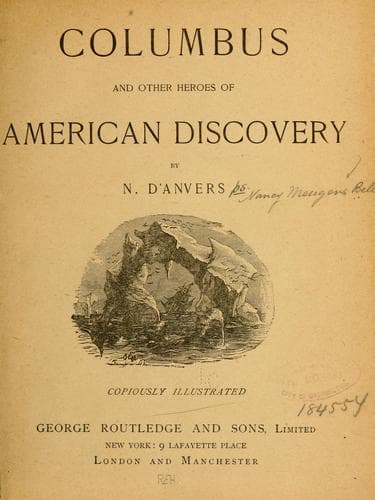
Columbus and Other Heroes of American DiscoveryD'Anvers, N.
History
Columbus and Other Heroes of American Discovery
D'Anvers, N.
America -- Discovery and exploration; North America -- Discovery and exploration
Crossing the Gila, Kino ascended its northern bank, and came to a
country which he characterizes as the most wonderful ever seen by the
eye of man. Its people, who were “kind, generous, and hospitable,”
dwelt in well-built villages clustering on the banks of streams,
and employed their time in the manufacture of a kind of cotton
cloth and of very beautiful feather-work. They were also skillful
picture-writers, and on the walls of their public buildings was
preserved a pictorial record of their history. Mines of gold and
silver――which they understood how to work with considerable skill,
though they set but small value on the ore when excavated――promised to
yield a splendid return to the emigrant, while immense flocks of sheep
and herds of cattle constituted another source of almost inexhaustible
wealth.
Worshiping the sun as the one supreme God, these simple yet
intelligent natives kept a fire ever burning on their altars in his
honor. With its undying flame they connected their own prosperity,
and they therefore showed little readiness to substitute for it any
less material guarantee of well-being. Father Kino made few converts
to the belief in the spiritual God, whose altar is the heart, and
whose chief purifying agent is adversity; and, passing on among the
fire-worshipers, he trod his weary way in a north-westerly direction
till he came to the so-called Fire Mountain, supposed to have been the
San Francisco Mountain. Here he altered his course for the East, and
after a long tramp through the forest, he reached the head-waters of
the Mimbres, the course of which he followed till its waters suddenly
sunk away in the earth, a phenomenon often since commented upon by
modern travelers.
Many months were spent by the missionary in the wild districts on
either side of the eccentric Mimbres, with little or no result so
far as his main object was concerned, the native tribes being then,
as now, peculiarly averse to the reception of religious teaching.
Finding it useless to remain longer among them, our hero therefore
at last resolved to return to Mexico, and there obtain recruits for
the further prosecution of missionary work in the more hospitable
Arizona. After no less than seven years of fruitless effort, he at
last accomplished his purpose, and toward the end of 1670 we find him
starting with three other Jesuits for the Gila, on the banks of which
he established a mission for the conversion of the Yaquis in 1672.
Between that date and 1679, no less than five missions were founded
among these and others of the New Mexican tribes, the Pueblos, Opotoes,
etc., themselves aiding in erecting the beautiful buildings, the ruins
of which, especially that of San Xavier del Bac, in the beautiful
Santa Cruz valley, still bear witness to the religious zeal and
architectural skill of these early teachers in the West.
Public-domain text, read in full here on John Shaqi.
Reviews
Reviews
No reviews yet
Be the first to share your thoughts on this work.
Elsewhere in the archive
Join the Discussion
Join the discussion
Sign in to leave a comment or review.
Sign InorCreate an account