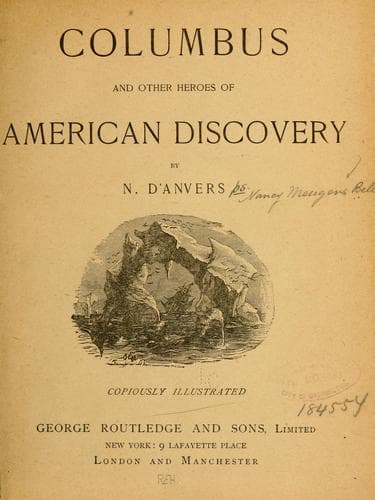
Columbus and Other Heroes of American DiscoveryD'Anvers, N.
History
Columbus and Other Heroes of American Discovery
D'Anvers, N.
America -- Discovery and exploration; North America -- Discovery and exploration
Early in October the travelers entered the districts occupied by
the Mandans, a native tribe holding some very peculiar notions with
regard to the powers of the Great Spirit, whom they also called
the Great Medicine, recognizing his agency in every cure of ill,
whether physical, mental or temporal. Unfortunately, in spite of this
strangely advanced creed, the Mandans were a degraded and dissolute
race, ready to give and equally ready to take offense; the tomahawk
being the usual weapon resorted to for revenge.
In spite of the unpromising character of the people among whom they
found themselves, the American leader resolved, as the season was now
so far advanced, to build a fort in the Mandan country in which to
spend the winter, and to resume their task with fresh ardor in the
ensuing spring. The friendship of the Mandans and of the Minnetarees,
dwelling in the highlands of Minnesota on the east, was conciliated by
presents, etc., and a site chosen for the fort in N. lat. 47°. Aided
by the advice and assistance of a number of the English Hudson’s Bay
Company, and of a Canadian Frenchman who had spent some time among the
Cheyenne Indians, the soldiers quickly constructed, not only a fort
for their protection, but a number of cabins for their comfort; and
the whole of the winter was passed in studying the ways of the natives,
hunting, etc., the monotony of the residence in the spot being often
relieved by visits from French or Canadian fur-traders, from whom much
valuable information was obtained.
Early in April of the ensuing year, 1805, the camp at Fort Mandan, as
the temporary settlement had been called, was broken up, and the party,
now numbering thirty-two, and with their means of navigation increased
to eight boats and canoes, once more embarked on the Missouri. To aid
in intercourse with the Shoshone or Snake Indians of Montana, Idaho,
and Oregon, two interpreters were secured, namely, George Drewyer and
Toussaint Chabornæan, the latter of whom was accompanied by his wife,
a young Snake woman who had been taken prisoner by his tribe some time
before.
Illustration: YELLOWSTONE LAKE.
Public-domain text, read in full here on John Shaqi.
Reviews
Reviews
No reviews yet
Be the first to share your thoughts on this work.
Elsewhere in the archive
Join the Discussion
Join the discussion
Sign in to leave a comment or review.
Sign InorCreate an account