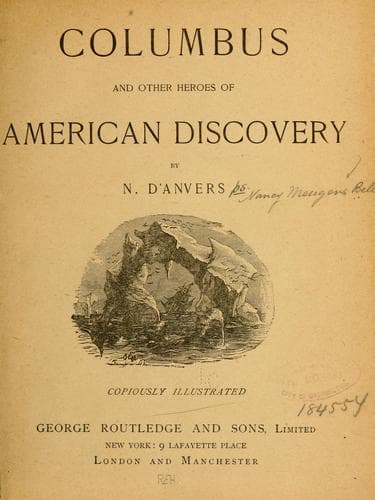
Columbus and Other Heroes of American DiscoveryD'Anvers, N.
History
Columbus and Other Heroes of American Discovery
D'Anvers, N.
America -- Discovery and exploration; North America -- Discovery and exploration
Instead of the arduous climb associated as a matter of course with the
scaling of the Rocky Mountains, Fremont now found himself ascending
a sandy plain, which brought him, imperceptibly as it were, to the
primal home of many a river flowing into the Pacific. The watershed
――as unique in its character as the swamps which nurse the infancy
of the Mississippi and the St. Lawrence――left behind, Fremont led his
little band up a long and beautiful ravine, discovering, a few miles
further on, a lake “set like a gem in the mountains.”
The newly-found sheet of water, which was ascertained to be the source
of one branch of the Colorado of the West, was named Mountain Lake;
and the instructions of the Government having now been fully carried
out, it was resolved to return eastward. Before sounding the retreat,
however, Fremont noticed a lofty mountain peak in the vicinity of
the South Pass, and resolved to ascend it. This turned out to be a
matter of considerable difficulty. First the mules were left behind,
then boots and stockings were discarded, the use of the toes being
absolutely necessary to the advance of the climbers.
Fremont himself was the first to reach the summit. Availing himself of
a kind of comb of the mountain, he gained a point with an overhanging
buttress, round which he crept, putting hands and feet in the crevices
between the blocks, and often hanging over a vertical precipice
several hundred feet deep, where a moment’s giddiness would have
been fatal. At last he stood, to quote his own words, “on a narrow
crest about three feet in width, with an inclination of about 20°
N., 51° E.;” and though he did not know it then, he had reached the
highest point of the great Rocky Mountain Range, 13,590 feet above
the sea-level――a point still known, in honor of its discoverer, as
Fremont’s Peak.
As he paused to rest, and gazed down upon the lovely view at his feet,
stretching away to the shores of the Pacific, Fremont relates that a
solitary bee came flying up from the eastern valley, and settled on
the knee of one of the men, “A moment’s thought,” he adds, “would
have made us let this solitary pioneer of the advance of civilization
continue his way unharmed; but we carried out the law of this country,
where all animated nature seems at war.” The bee was caught, killed,
and placed among the flowers collected on the way up; and in this
slight incident we read a melancholy prophecy of the fate awaiting the
human inhabitants of the lands now for the first time brought within
the limits of that civilization which has never yet proved itself wide
enough to contain the red man and the white.
Public-domain text, read in full here on John Shaqi.
Reviews
Reviews
No reviews yet
Be the first to share your thoughts on this work.
Elsewhere in the archive
Join the Discussion
Join the discussion
Sign in to leave a comment or review.
Sign InorCreate an account