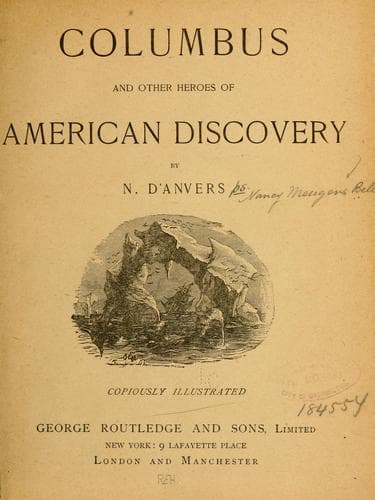
Columbus and Other Heroes of American DiscoveryD'Anvers, N.
History
Columbus and Other Heroes of American Discovery
D'Anvers, N.
America -- Discovery and exploration; North America -- Discovery and exploration
From the summit of Fremont’s Peak the explorers could see on the one
side the innumerable lakes and streams among which sprang the Colorado
of the Gulf of California, while on the other lay the romantic Wind
River Valley, whence flows the Yellowstone branch of the Missouri;
while far away on the north rose the snow-crowned heads of the Trois
Tetons, the first homes of the Missouri and Columbia, with the less
lofty peaks at the southern extremity of the range which witnessed
the birth of the Nebraska. Of the whole scene, the most remarkable
characteristic was, and is, the traces of terrible convulsions of
nature. The chain is split from end to end into ridges and chasms,
alternated with thin walls of rock, broken at their terminations into
natural minarets and columns, producing an effect of weird, unearthly
beauty peculiarly striking.
Noting, however, but the main features of a district now associated
with so many scenes of adventure in the great rush of emigration
westward so soon to follow, Fremont hastened back to his camp in the
South Pass, and thence returned to Fort Laramie, which he reached
in safety without the loss of a single man, all the prophecies as to
the dangers awaiting him being unfulfilled. A few weeks later, his
report was in the hands of his Government, who marked their sense of
their services by at once appointing him to the command of a second
expedition; this time with orders to connect the work he had already
done with that of Wilkes, by examining the country between the
southern half of the Rocky Mountains and the shores of the Pacific.
With this end in view, Fremont, accompanied by some thirty-nine
men――Canadians, Creoles, and Americans――started from Kansas, near
the junction of that river with the Missouri, early in June, 1843.
Following the now well-beaten emigrant tracks for the West, the
expedition reached the Rocky Mountains considerably to the south of
the pass discovered on the previous trip, and near the connecting
ridge between the Utah or Bear River Mountains and the Wind River
chain. This ridge separated the waters flowing to the Gulf of
California on the east, and those on the west which run more directly
to the Pacific, from that vast inland basin of lakes with no outlet
to the ocean.
Crossing the Rocky Mountains, the party entered the fertile and
picturesque valley of the Bear or Utah River, the chief tributary of
the Great Salt Lake, first alluded to by Baron La Hontan in 1689, but
never before visited by any white man except wandering trappers, whose
eyes had been blind to the wonderful nature of the phenomenon now to
be examined.
Public-domain text, read in full here on John Shaqi.
Reviews
Reviews
No reviews yet
Be the first to share your thoughts on this work.
Elsewhere in the archive
Join the Discussion
Join the discussion
Sign in to leave a comment or review.
Sign InorCreate an account