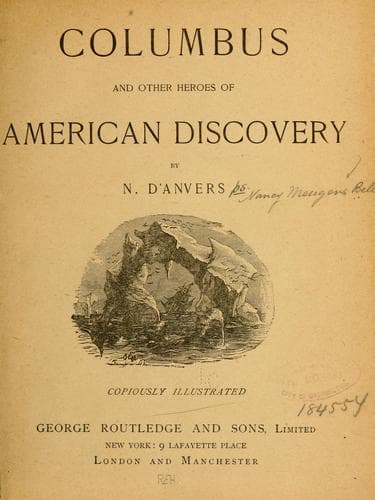
Columbus and Other Heroes of American DiscoveryD'Anvers, N.
History
Columbus and Other Heroes of American Discovery
D'Anvers, N.
America -- Discovery and exploration; North America -- Discovery and exploration
While the indefatigable hero was ascertaining the exact position of
the newly-found sheet of water, a few half-naked Indians, speaking a
dialect of the Snake language, made their appearance, and said they
lived in the rocks hard by, and that there was a river at the end of
the lake. Cheered by being again in a country where human beings could
live, Fremont led his party round the lake to the so-called river, and
found it to be merely a fresh-water stream flowing into, not out of,
the Pyramid. This at once convinced him that he had discovered, not
the head-waters of any river, but a vast interior lake without outlet.
The last of the cattle brought for provisions for the party had
been killed a day or two previously, and it was now a question of
the utmost moment whether an attempt should be made to pierce the
mountains on the east or go down through those on the west to the sea,
when a number of Indians came out of a neighboring thicket who said
their water was full of fish. The camp was at once pitched, and a
little later the hungry explorers were enjoying a hearty meal of
salmon trout. The natives, however, could give but little information
about their country. They made a drawing of their river on the ground,
representing it as issuing from another lake in the mountains three or
four days distant, beyond which was a single mountain, and further
away still were two rivers, on one of which white people like their
guests traveled.
Whether these white people were settlers on the Sacramento, or
travelers from the United States, there was no evidence to show; and
after a long and eager discussion with his followers, Fremont resolved
finally to abandon all idea of returning to the United States for
the present, and to cross the Sierra Nevada into the valley of the
Sacramento. This decision was greeted with eager acclamation by all
concerned; and although the Indians assured him that the mountains
were altogether impassable in the winter, not a moment was lost in
preparing for the arduous undertaking.
The first peak of the most easterly range of the mighty rocky barrier
was scaled on the 20th January; but a violent snowstorm coming
on compelled the travelers to turn southward, and encamp on the
eastern side of the mountains. A little further on a large stream was
discovered, which was followed to its outlet from the mountains, where
the ascent of the ridge was again commenced. A wild and narrow pass,
through which ran an Indian trail, with mountains on either side cased
in snow and ice, led up to a lofty height, looking down from which,
several natives were seen skimming and circling about on snow-shoes.
Public-domain text, read in full here on John Shaqi.
Reviews
Reviews
No reviews yet
Be the first to share your thoughts on this work.
Elsewhere in the archive
Join the Discussion
Join the discussion
Sign in to leave a comment or review.
Sign InorCreate an account