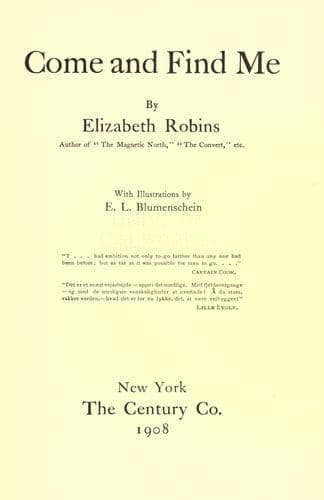
Alaska -- Fiction; California -- Fiction; Gold mines and mining -- Fiction
If we are late, we know “Uncle” Fielding will be looking out for us. Even
if I fail to distinguish his kind, dark face, I see the whites of his
eyes shining, I hear his rich voice lowered to reproach that I should be
abroad so late in the vast Annuttalagga woods that go to the verge of the
world.
But Uncle Fielding has his share in my idleness, for he knows the stories
I like best of all. When I’ve gone to sit within the radiance of the
great open fireplace (less for warmth than for sake of cedar scent and
love of the flaring, singing resin in the pine), Uncle Fielding will come
staggering in under the weight of a single log, and having thrown it
down, will tarry awhile. To my polite hope that he feels at home in his
new cottage, he replies with gentle assurance: “I’ll haf to be mighty ole
and mighty painful befoh I leave this hilltop.” With humility I learn to
see myself as the transient one, the visitor, and Uncle Fielding as the
one who rightly is “at home.” Even for neighborly credit and fair regard
I look to him. For when one of the younger generation, or some mere
new-comer ventures: “They say, in the old days, you knew her brother,”
“_Knew_ him?” says Uncle Fielding loftily, “_I raised him_—” and so
re-establishes our respectability in a land that for so many years has
known us only as little-remembered names.
Can you not see that with the vivid intervention of all this new-old
life—the story you bade me write has in a brief space gone to a distance
so illimitable that beside such a standard of remoteness, Florida is
neighbor to the Pole? I tell you plainly that if this book of yours
is ever to be finished, you must send me something of that influence
that has so often spurred me on before. Once even here, a touch of it,
like your hand on my shoulder, reached me one evening, in spite of
all the hosts of Hernando. Walking about at sunset to count how many
mangoes were growing near the house—I was pursued as far as the great
ilex at the gates by faint intermittent strains of some unearthly
music. I looked up, thinking of those “harps” that Hilda heard and to
whose strains she unsealed the Master Builder’s ears. Again that music!
faint but unmistakable; sad and wild, with its vaguely inciting call.
A little shamefaced for my fancy, I said to one who knew not Hilda: “I
could almost swear I heard harps in the air.” “Yes,” was the answer,
“on the roof,” as though it were the most natural thing on earth that
a carpenter, instead of making us rain-proof, should devise and lash
in place a wind-harp over our heads! I thought how you would have
disapproved that man—and cherished him.
Public-domain text, read in full here on John Shaqi.
Reviews
Reviews
No reviews yet
Be the first to share your thoughts on this work.
Join the Discussion
Join the discussion
Sign in to leave a comment or review.
Sign InorCreate an account