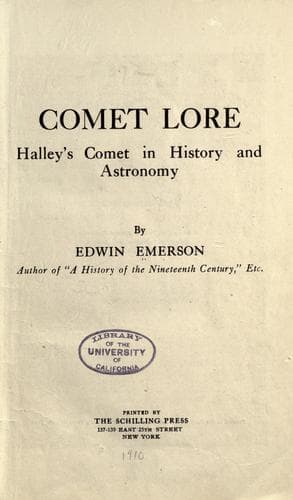
Comet Lore: Halley's Comet in History and Astronomy — John Shaqi
Comet Lore: Halley's Comet in History and AstronomyEmerson, Edwin
History
Comet Lore: Halley's Comet in History and Astronomy
Emerson, Edwin
Comets; Halley's comet
Aristotle records a Comet seen by him in his fifteenth year, 371 B. C.
The sight of it inspired the youth to a special study of astronomy.
The Comet was visible until the end of the first week of July. On July
eighth was fought the great battle between the Thebans and Spartans,
when Epaminondas, one of the greatest generals of antiquity, overthrew
the Spartans.
The next Comet, that of 338 B. C., which was likewise observed by
Aristotle, who had then become the teacher of Alexander the Great,
marked Alexander’s first public entry into the history of the world.
The Comet blazed its brightest on the eve of the bloody battle of
Chaeronea, Alexander’s first victory and achievement in war.
In the year 344 B. C., there was another Comet, followed by another
war in Greece and Sicily. Diodorus of Sicily wrote of this Comet: “On
the departure of the expedition of Timoleon from Corinth for Sicily
with all his war ships, the Gods foretold success by an extraordinary
prodigy: A burning torch appeared in the Heavens for an entire night
and went before the fleet into Sicily.”
_The Comets of Carthage._
Nearly a hundred years passed before the appearance of another Comet in
240 B. C. This is the first recorded appearance of Halley’s Comet. By
the light of this Comet, Hamilcar, the great Carthaginian general, made
his young son Hannibal swear eternal enmity to the Romans. Hamilcar was
then in the midst of preparations for the war against Rome, which broke
out soon afterward.
Comets appear to have been stars of special omen to Hannibal and to his
native city, Carthage. Twenty years later, appeared another Comet which
shone over Carthage for 22 nights. Its appearance was followed by the
outbreak of the great war between Hannibal and the Romans, and by a
terrible earthquake in Greece.
The next Comet shone in 204 B. C., when Hannibal suffered his first
bloody defeat by Sempronius, while Scipio, Hannibal’s arch enemy, was
crossing over to Africa, for the first attack upon Carthage.
The appearance of the next Comet, twenty years later, 184 B. C., which
shone through 88 nights over Asia Minor “with a horrible lustre” was
followed by the death of Hannibal. Soothsayers at the court of King
Prusias of Bithynia, in Asia Minor, whither Hannibal had fled from
the Romans, told the King that the Comet betokened Hannibal’s early
death. This so wrought on Hannibal’s spirit that he ended his life with
poison.
In the year 150 B. C., appeared another Comet “of horrible size.” It
was seen for many nights running all over the Mediterranean Sea. Its
appearance was followed by the outbreak of the third great Punic War
between Rome and Carthage.
Within four years another Comet, blazing over northern Africa in 146 B.
C., was followed by the fall of Carthage, which was stormed and utterly
destroyed by the Romans.
_Mithridates’ Star._
Public-domain text, read in full here on John Shaqi.
Reviews
Reviews
No reviews yet
Be the first to share your thoughts on this work.
Join the Discussion
Join the discussion
Sign in to leave a comment or review.
Sign InorCreate an account